Chao embroidery
Chao embroidery is a branch of Guangdong embroidery, worked in the Chaoshan region. What sets it apart from Su, Xiang and Shu embroidery is that the ground is padded so the pattern stands out: the relief can reach fifteen centimetres, and it gives under the fingers.

What it is是什么
Chao embroidery belongs to Guangdong embroidery. In 2006, Guangdong embroidery — Chao and Guangzhou together — was approved by the State Council for the first national list of intangible cultural heritage, with Chaozhou city as the applicant. On 10 November 2025 the National Intellectual Property Administration, in announcement No. 651, gave ‘Chao embroidery’ preliminary recognition as a product of geographical indication, on the application of the Chaozhou municipal government. The area of production is eleven townships: the five sub-districts of Taiping, Xixin, Qiaodong, Chengxi and Fengxin in Xiangqiao district; the four towns of Tiepu, Linxi, Guantang and Yixi; and Jiangdong and Fuyang towns in Chao’an district.
One thing is easily confused: Chao embroidery and drawn work are not the same. In drawn work the warp and weft threads of the cloth are drawn out following the pattern and the gaps joined with thread to make an openwork figure, mostly for tablecloths, handkerchiefs and other export goods. In Chao embroidery the pattern is worked onto the surface with a separate thread. Both belong to the embroidery tradition of the region, one taking the export road and one the home market, and in everyday speech they are run together; in writing they have to be kept apart.
How it is stitched怎么绣
The core is raised work and nailed gold work, built from five basic moves: pu, laying a coarse thread down where the ground is to be raised; dian, padding it up and firm with paper twists and cotton wadding; ding, nailing gold and silver thread over the padding; and jie and zhui, for joins and for finishing. The relief runs from 0.5 to 15.0 centimetres by the protection specification, with the hollows left flat and smooth.
The stitching falls into three classes:
- Velvet stitch: velvet thread worked flat on the ground, judged by the flow of the line. It divides again into flat velvet work, using even stitch, joining stitch, spreading stitch and seed stitch, and padded velvet work, where the padding goes down first and the stitching follows with its own two stitches.
- Nailed gold work: gold and silver thread first, velvet second, again in a flat and a padded form. Flat gold work is strict about the placing of the nails: row is set against row ‘staggered and symmetrical’, that is, the nails of the second row fall at the halfway point of the first.
- Gold and velvet together: the two worked side by side, either in separate stretches of the same panel or one over the other.
There are more than a hundred stitches. The common ones are the pictographic stitch, the brocade stitch, the flower stitch, the bamboo-weave stitch and the pine-seed stitch; among the auxiliary stitches are the turning stitch and the binding stitch. One stitch is Chao embroidery’s own: ‘two-needle dragon scale’, in which gold thread is coiled into discs smaller than a drawing pin and the discs laid one over the next so that the lower edge of each scale can be lifted. The nailed-gold Nine Dragons screen, which took the gold cup at the 1982 national arts and crafts hundred flowers awards, is worked in it.
The classification runs two ways: one account divides the work by technique into three classes (velvet, nailed gold, gold and velvet together), another by material into five (nailed gold, gold and velvet, velvet, thread work and so on). Both are in use; this page follows the first and records the second.
The sequence of work工序
By the protection specification the hand process runs: design, drawing, pricking the drawing, pouncing it onto the cloth, keeping a sample, stretching on the frame, matching and grading the threads, embroidery, mounting (with sewing and the rest of the finishing), and inspection. To take a dragon’s head as the example, four steps: outline the shape and structure in line; pad with cotton and paper twists to bring out the bone and the whiskers; lay gold thread over the padding; and finally draw the lines with paper twists wrapped in silk velvet, with eyes, brows and tongue changed to velvet thread.
Where it is used用在哪里
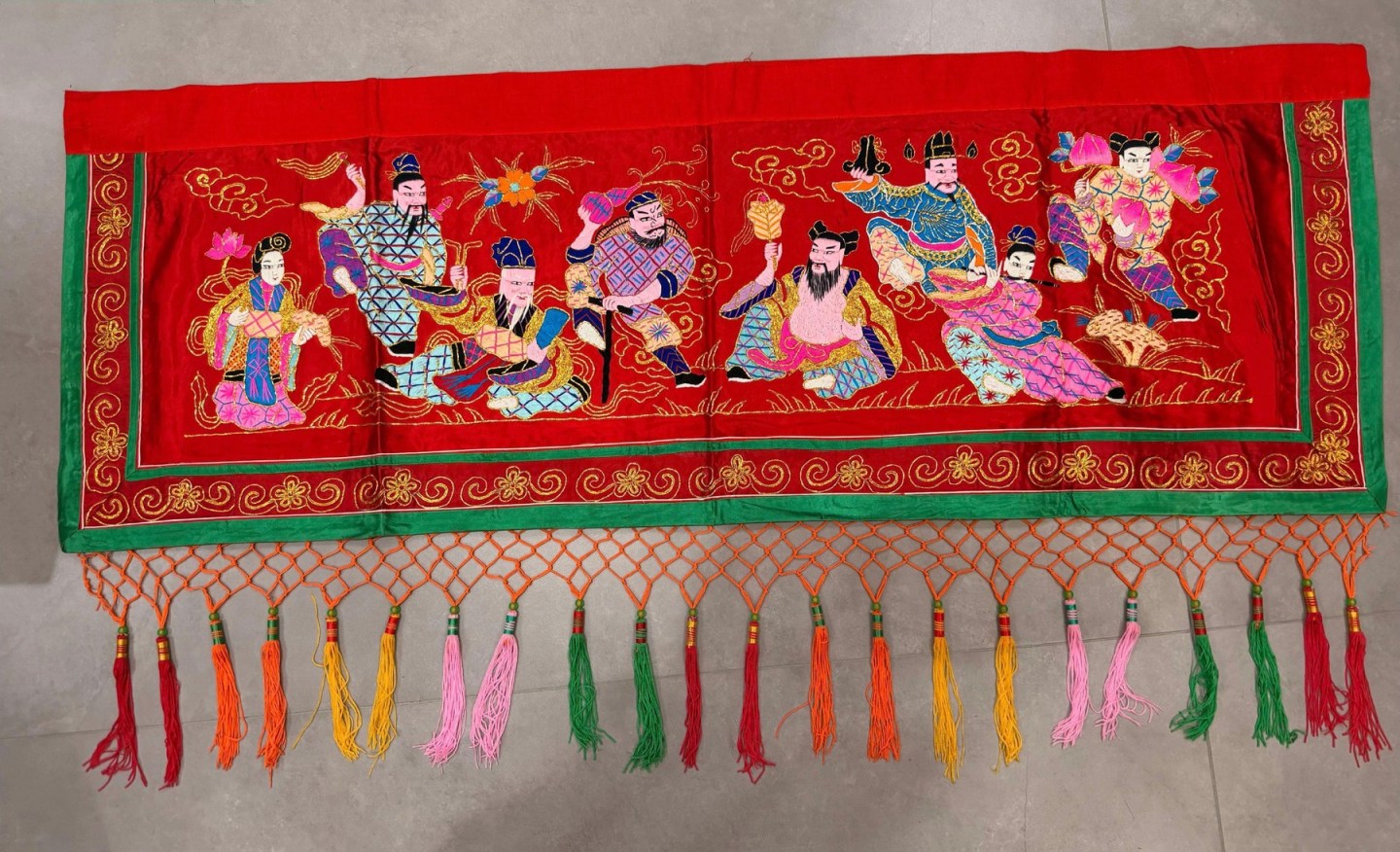
By traditional use the main destinations are the fittings of ancestral halls, temples and stage fronts, and then stage costume, ceremonial dress, curtains and hanging panels. This matters: Chao embroidery is not an object for looking at. It lives where the rites are held — the robe of a god, the skirt of a bride, the curtain of a stage — and the patterns come from there too: dragons and phoenixes, the qilin, the crane, peony, the vase, and figures out of myth.
(A third-party photograph stood here without permission and has been taken down. A replacement waits on the rights holder; no substitute image is being used in the meantime.)
A century of change近百年的一段沿革
The style took shape in the Ming, spread widely among the people in the Qing, and reached its height from the late Qing into the early republic, when more than twenty embroidery houses traded in the region. Most closed after the war with Japan. In 1951 the city of Chaozhou gathered the thirteen houses that remained into a trade association for Gu embroidery; in 1952 Chao’an county set up a drawn-work company with a Gu embroidery department inside it; in 1956 the individual embroiderers were organised into a drawn-work and embroidery cooperative and a separate embroidery cooperative; in 1962 the name became the Chaozhou state embroidery factory; and in 1980, on the embroidery room of the arts and crafts institute, the Chaozhou embroidery research institute was founded to sort out the old stitches and patterns.
Two related listings: drawn work, in both the Shantou and the Chaozhou forms, entered the fourth national list in 2014; Guangdong embroidery in its beaded form entered the fifth in 2021.
Who works at it谁在做
The national bearers have been named batch by batch; these are the ones on the register for this branch:
- Lin Zhicheng (born October 1922), first batch, number 01-0082.
- Kang Huifang (born July 1948), a woman, fourth batch. She learned to embroider as a child and was picked by the older embroiderer Lin Wanying for the state embroidery factory; she worked on the great padded screens Nine Dragons and Phoenixes Playing to the Flute; she has been deputy director of the Guangdong embroidery institute and technical director of the Xiangqiao embroidery research centre, and has trained more than a hundred students.
- Sun Qingxian (born June 1950), fourth batch, number 04-1772.
- Li Shuying, a woman, on the register.
Names, batches and numbers follow the project page for Guangdong embroidery (Chao embroidery) on the China intangible cultural heritage site: project number Ⅶ-20, category traditional fine art, applicant Chaozhou city, Guangdong.
The plates图版
One nailed-gold piece is taken from a stock image; a photograph of a temple valance was withdrawn for want of permission.
Close shots of the reverse of the work and of the raised edge in section are not to be had in the public plates. That the relief stands from 0.5 to 15 centimetres is not something a photograph taken from the front can show.
Between one area and another区域之间
‘Chao embroidery’ is a cover-all term; brought down to a county or a city, the uses and the trade routes differ. What follows lists only the differences that can be checked, and draws no conclusion.
- The prefectural city (Xiangqiao, in Chaozhou): the embroidery houses were thickest here, more than twenty from the late Qing into the early republic. The output was mostly robes for temple gods, valances, stage curtains and wedding dress, and this is where raised work and nailed gold were used most heavily.
- Shantou: a treaty port, it became the export gateway. Drawn work — lace, openwork table linen — went abroad, running as a second line beside Chao embroidery for the home market; the beaded form of Guangdong embroidery, listed in the fifth national batch in 2021, was applied for by Shantou city.
- Jieyang: the local craft gazetteers set drawn work beside stone carving, gold-lacquer woodcarving and New Year prints as traditional crafts; no separate entry for Chao embroidery has been found.
- Chaoyang, Puning, Huilai and elsewhere: embroidery for ritual use — god robes, long banners for longevity, valances — is to be seen in ancestral halls and temples, but the public record is scattered and will not yet carry a judgement by district.
What has to be said is this: these differences lie mostly in use and in the trade route, and do not necessarily match a division in stitch. Local gazetteers, the heritage lists and the talk of the trade do not agree with one another, and no unified division by district has been published. The page states the matter and stops; if objects and bearers from each district can be compared later, it can be added to.
A detail细部图录

Sources来源
Announcement No. 651 of the National Intellectual Property Administration, Requirements for the protection of Chao embroidery as a product of geographical indication (10 November 2025); the project page for Guangdong embroidery (Chao embroidery) on the China intangible cultural heritage site; and the local gazetteer office of the Guangdong provincial government, The intangible heritage craft in Guangdong dress. All accessed 18 October 2026.
Home › Heritage › Heritage list › Chao embroidery
Last revised: 5 November 2026