The ritual year


What this section covers
The observances of the year, arranged by lunar date and by solar term: New Year’s Eve, Spring Festival, Lantern Festival with its god processions, Qingming, the Double Fifth, the Double Seventh, the Yulan assembly, Mid-Autumn, the tile-kiln burning, and the winter solstice. Each page records three things — how the day is kept, when it falls, and why it falls then.
Dates are never cut loose from the calendar: wherever a solar term, a lunar phase or a sexagenary day is involved, the astronomical calendar on this site can be checked.
Rites for the unattached dead, the Yulan assembly and the god processions are recorded here as village custom — seasonal observance and the mutual aid that goes with it. The pages describe; they neither endorse nor instruct.
Pages in this section
In the order the days come, one page to each observance; the title takes you there.
- Last day of the twelfth month: New Year’s Eve in Chaoshan — offerings to the ancestors, fresh peach-wood charms on the door, a brazier set in the hall to sit around, the family reunion meal, and firecrackers, gongs and conch horns to drive off evil and thieves.
- First day of the first month: Spring Festival customs — a vegetarian offering at dawn, the young and old bowing in turn, callers at every door, and on the fifth day cattle brought in with exorcist dance.
- Seventh day of the first month: Renri and the seven-vegetable stew — seven greens of the season boiled in one pot, the list varying by village, chosen for lucky homophones.
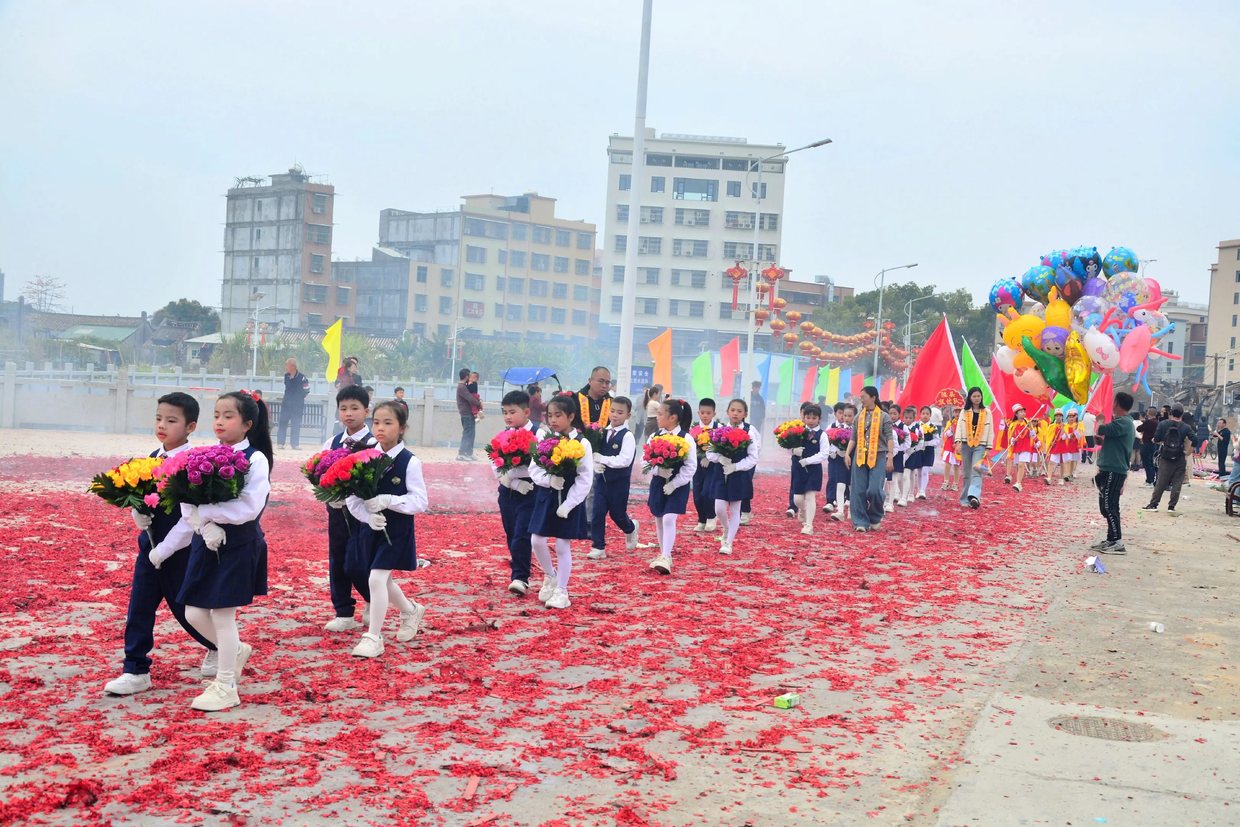
- Fifteenth day of the first month: Lantern Festival and the god processions — images carried around the parish bounds on the first full moon; village lantern fairs open on the sixth; antiphonal singing and rope swings are the old amusements.
- Qingming solar term: Tomb-sweeping at Qingming — each branch of a lineage takes its own day, spread over a fortnight or so; on the hill the earth god is offered to first, then the ancestors; the season’s food is polzi cake.
- Fifth day of the fifth month: Double Fifth customs — mugwort and calamus at the door, pyramidal rice dumplings, water drawn at noon for washing, races on the river, and gardenia cakes and dumpling balls on the table.
- Seventh day of the seventh month: The seventh of the seventh — longans in season, called “tying the star”; children who have reached fifteen sui leave the garden that day. Two things on one date.
- Throughout the seventh month: The Yulan assembly — villages take turns raising orphan platforms and feeding the unattached dead, chanting the flame-mouth rite and scattering rice cakes and rice; after the service the offerings are scrambled for below the platform, and Chaozhou opera is sung at night.
- Fifteenth day of the eighth month: Mid-Autumn in Chaoshan — moon-watching with taro peeled, “skinning the ghost”; children build tile towers and set them burning; the lard-pastry mooncakes carry a spiral on top with a red dot at the centre.
- Mid-Autumn night: The tile-kiln burning — tiles stacked into a tower, filled with firewood and burned until the whole stack glows, flames escaping through holes left in the sides. The whole village builds it.
- Winter solstice: The winter solstice and winter-festival balls — called the winter festival; glutinous rice balls in syrup, and in the old practice stuck on doors, windows and utensils to feed the household’s rats.
All eleven are online. Each takes the “customs” chapter of the prefectural gazetteer as its frame, keeps present practice apart from the old record, marks differences between counties, and gives sources item by item at the foot.
Two further topics, kept separate
The eleven above each describe one festival on one date. The next two are different: no single date governs them. Villages pick their own, one village one slot, so each has its own page and its own table, reached from here by a separate route.
- Throughout the seventh month: Feeding the unattached dead — the universal deliverance and Yulan assemblies, villages taking turns to raise the platforms, fifty places each named down to town and village, with the dates of temple and charity-hall services as well.
- Tenth month to the twelfth: Thanksgiving to the gods — the year-end thanks for a year of divine favour: 168 places in Chaoyang, Chaonan and Haojiang districts of Shantou, five in Jieyang, one in Chaozhou, ending on the twenty-fourth of the twelfth month when the gods go up to heaven.
How to read this section
The timing of a festival is not arbitrary. Three systems of reckoning lie stacked behind it. Confuse them and the answer to “why this day” comes out wrong.
Three reckonings
- Lunar month and day: the first, the fifteenth, the twenty-fourth, counted on the synodic month. The Lantern Festival on the fifteenth of the first month and the Yulan on the fifteenth of the seventh are both fixed by the phase of the moon.
- Solar terms: fixed by the sun’s ecliptic longitude. Qingming and the winter solstice belong here. Solar terms are solar in nature and have nothing to do with the moon, which is why their Gregorian date stays close from year to year while their lunar date moves.
- Sexagenary reckoning and day-selection: some rites take a separately chosen auspicious day, running alongside the season. Such days follow the stems-and-branches cycle and local day-selection custom, and fall outside the two systems above.
Why the same festival falls on different days
Three reasons. Intercalary months: in a year with a leap month the whole sequence shifts back. Local day-selection: the same festival has a fixed village day in different parishes. And county habit: leaving the garden, for instance, is mostly a first-month affair in the prefectural city but is kept on the seventh of the seventh month in Shantou, Jieyang, Puning and Chaoyang.
Counties, not one voice
The seven counties of the prefecture share an origin and diverge in practice. The same festival may fall on different days in Haiyang and Chaoyang, with different offerings in Raoping and Huilai. Each county is recorded separately; they are not merged into a single “this is how Chaoshan people keep it”. Where a county cannot be pinned down, the variants are set side by side rather than one being promoted to the rule.
The vocabulary of the year
Fifteen terms under “festivals” in the glossary, in the order the days come, one page to each: pronunciation, meaning, and the words most easily confused with them.
- All year: the eight festivals of the year — Spring Festival, Lantern Festival, Qingming, Double Fifth, Yulan, Mid-Autumn, winter solstice and New Year’s Eve; ancestors are offered to at each, and the rice cakes change with the season.
- Seventh of the first month: seven-vegetable stew — seven greens of the season in one pot, the list differing from household to household, chosen for lucky homophones.
- First and second months: lantern head — the man who heads Outing’s second-month lantern fair, an office that comes round once in ten years; the district whose turn it is provides the lanterns and offerings and lays on the feast.
- Around Qingming: mouse-ear-herb cake and polzi cake — both put plants into the cake. Mouse-ear herb is pounded to juice for the skin, and the cake comes out a near-black green; new leaves of the pol tree are pounded into rice batter for a blue-green cake that splits open on top as it steams.
- Seventh month: Yulan assembly, feeding the dead, orphan platform, king of the orphaned, flame-mouth rite, scrambling for the offerings — one service from platform to scramble: Ksitigarbha enthroned above, a paper king of the orphaned set before it to hold the altar, food given by day, an opera troupe hired for the night, and once the main service ends on the final day, the offerings on the platform thrown down to the crowd.
- Mid-Autumn: lard-pastry mooncake, worship of the moon lady, tile-kiln burning — flaky pastry raised with lard; at night the women set a table for the moon with cakes, taro, pomelo and pomegranate; children gather broken tiles into a tower and feed it fire.
- Winter solstice: winter-festival balls — glutinous rice rolled into balls and boiled in syrup; eating them counts as another year added.
Calendar anchors
Solar terms, lunar phases and lunar dates are computed here from the JPL ephemeris, as at Kuang Chujia’s research site on historical astronomy and calendars. For the new moons, intercalary months, moments of solar-term entry and sexagenary days of a given year, use the astronomical calendar.
The first-month processions have a page of their own: the procession calendar (twenty dates, with Gregorian equivalents and travel checks).
Pronunciations and one-line glosses for the eight festivals, winter-festival balls, seven-vegetable stew and moon worship are in Glossary · festivals; laoye, ying laoye and biaoqi are under god worship and processions.
Last revised: 3 November 2026