Chaozhou porcelain mosaic
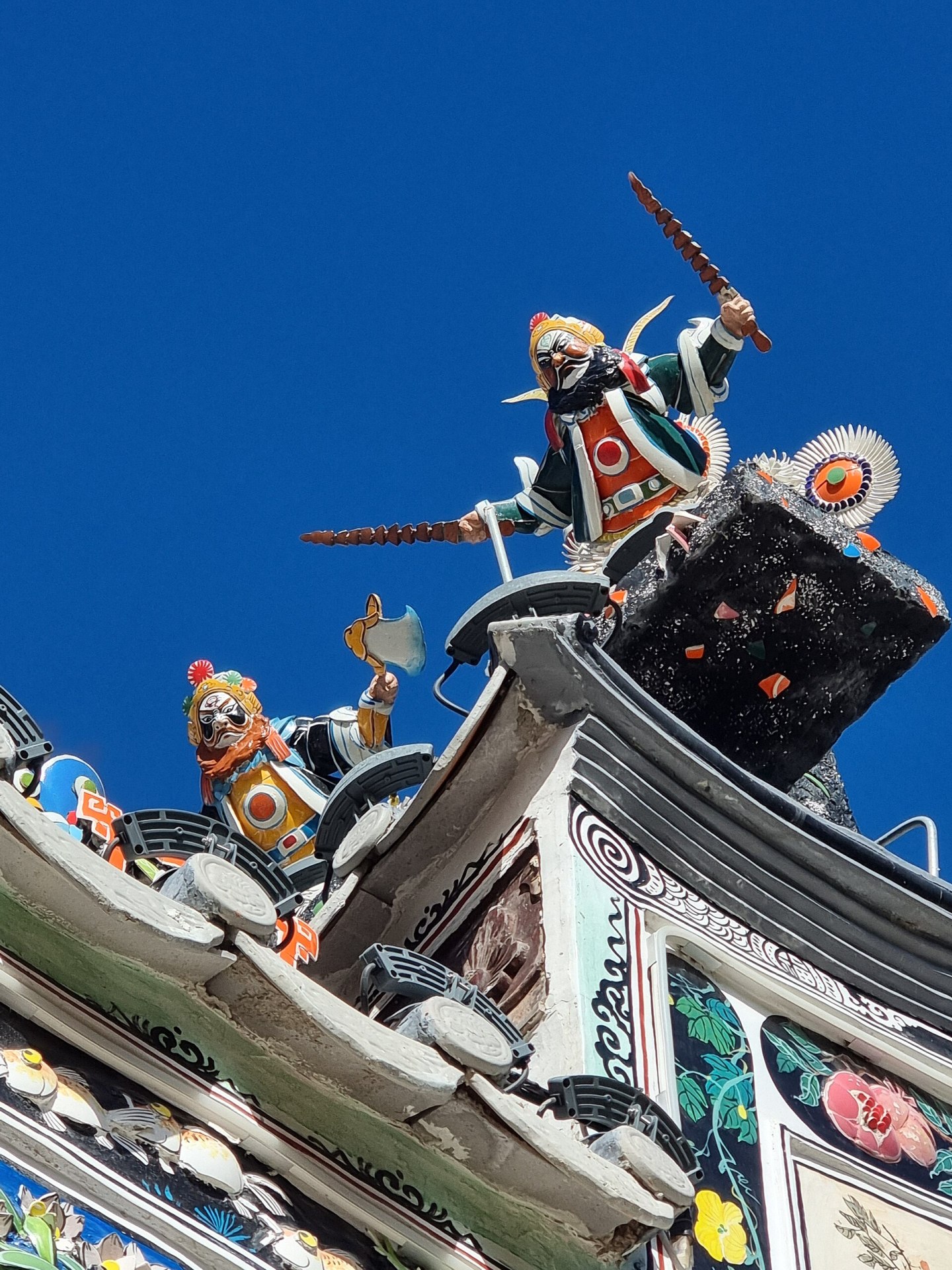
Porcelain mosaic is a picture put together from shards. It lives on the ridge and the gable of a house, and decades of sun and rain do not fade it — because the material was fired porcelain to begin with.
What it is一、是什么
Chaozhou porcelain mosaic is a craft of its own: coloured shards cut and set to decorate a building, or assembled into a single piece for display. In 2011 it entered the third national list of intangible cultural heritage, under the item name ‘xiang qian (Chaozhou porcelain mosaic)’.
Its character is a grand composition, brilliant colour, lively figures and a hard body that neither rain nor blazing sun will fade. It can be flat, or in relief, or modelled three-dimensional — flowers and plants, birds and beasts, figures out of opera.
How it came about二、怎么来的
In the Wanli years of the Ming (1573–1620) the potteries of Chaozhou were strong and popular sculpture busy, and the practice appeared of cutting shards into simple flowers and setting them on buildings. Through the Qing, mosaic spread over halls of lineage and houses. By the end of the Qing the kilns and the mosaicists were working together, firing bowls in specified colours for cutting — the division of labour was only complete at that point, and only then did mosaic become a craft in its own right.
The line of development says something: mosaic did not mature through the skill of its makers alone but through the potteries and the builders fitting together. Broken porcelain was waste, and it was turned into material.
How it is made三、怎么做
Four steps: building the core, cutting the shards, setting them, and pointing the joints.
- The core: a skeleton and a rough body are built in lime plaster — shell lime mixed with paper fibre, laid up layer by layer into the stance of a figure or the bone of a dragon. Dried through, it is the body the shards go on. If the core is out, no fineness of setting will put it right.
- Cutting: coloured bowls, plates and vases are broken to shape and cut with pincers into scales, feathers, petals and the folds of a robe. The colour comes from the glaze of the vessel — red, yellow, green, white, a shard from each. The cut is all in the hand: the curve of a single shard decides which way a scale curls.
- Setting: from the bottom up and from the back forward, one shard overlapping the next, the gaps filled with mortar. Faces are usually a single piece, drapery narrow strips; at a distance it reads as blocks of colour, and only close up are the edges of the shards seen.
- Pointing: once the mortar is dry the joints are filled and the edges trimmed, and the two ends of the ridge get their curling-grass terminations before the ridge counts as closed.

Its place on the building四、在建筑上的位置
There is a saying in Chaoshan that the roof carries a play, and it means that theatre on the ridge assembled out of shards. Mosaic sits mainly on the ridge and the gable. The treatment of a Chaoshan ridge is an important clue to rank and date, and mosaic is the most conspicuous part of it: the twin dragons on the main ridge, the beasts on the sloping ridges, the flowers, birds and figures on the gable, all built from broken porcelain.
With woodcarving and stone carving it makes up the three great lines of architectural ornament here — woodcarving on the beams, doors and windows, stone carving on the door surrounds and column bases, mosaic on the ridge and gable. The three together are the physical evidence for the saying that a Chaoshan house is built like a palace.

Related关联
The forms of the building are on si dian jin and xia shan hu; a companion craft on Chaozhou woodcarving.
Sources来源
The fifteen national heritage items of Chaozhou on the Chaozhou municipal government portal; and the Chaozhou mosaic entry in How much of the Chaozhou heritage do you know (China Youth Net). Accessed 18 October 2026.
Home › Heritage › Heritage list › Chaozhou porcelain mosaic
Last revised: 5 November 2026