Dawu clay figures
Dawu clay figures are made in Dawu village, Fuyang town, Chao’an district, and go back to the Southern Song. Their subjects come mostly from Chao opera: whatever is playing on the stage is what gets modelled.


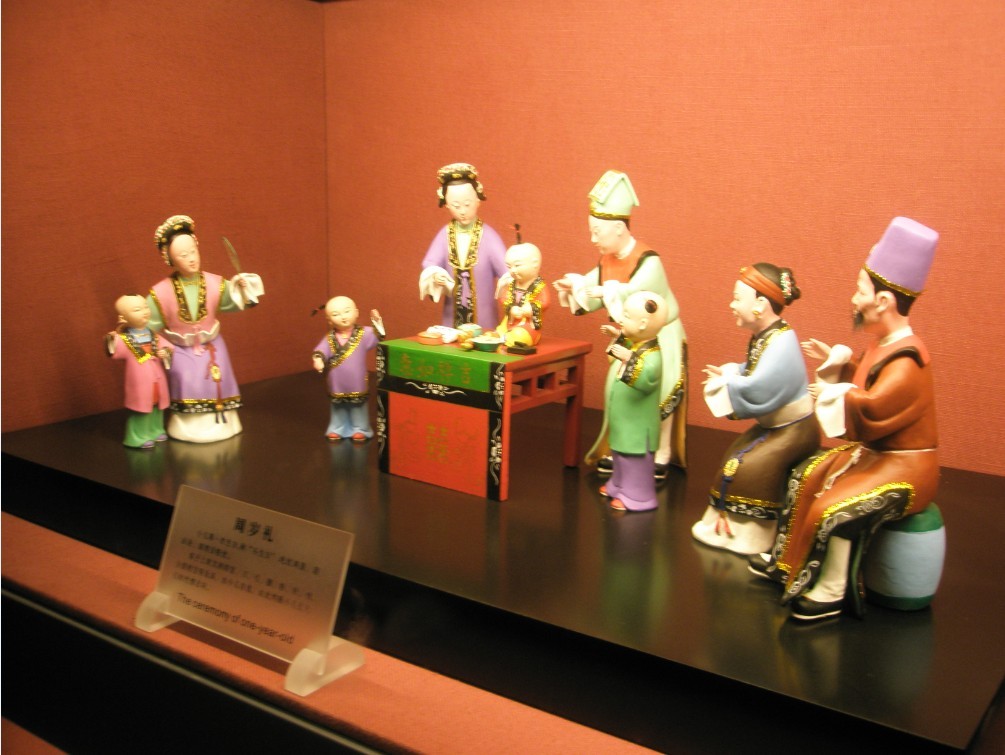

What it is一、是什么
The history of Dawu clay goes back to 1237, the first year of the Jiaxi reign of the Southern Song. It was at its height from the middle of the Qing to the early republic, when workshops ran through the whole village and more than a hundred makers are counted, Wu Panqiang among them. In 2008 it entered the second national list of intangible cultural heritage, in the category of traditional fine art.
Five kinds二、五大门类
- Figures from opera, divided again into wen shen, wu jing, chen jing, da fu pi and wen cun; of these da fu pi and wen cun have been lost for decades.
- Painted faces, children’s heads, puppet heads, lantern heads.
- Portraits, modelled from a living person; only an able maker can manage one.
- Gods and Buddhas, for worship and for looking at.
- Toys — animals, chubby babies, the carp boy — known together as ‘the mixed brocade’.
Of the five, the first explains the nature of the craft best: the subjects are taken from Chao opera, which makes the figures a by-product of the theatre. The troupe travels and the clay stays; when the audience goes home it takes the people of the play with it and stands them on a table.
The technique三、技法
Carving, modelling, pinching, pasting, incising, moulding and colouring were all brought to maturity, and it is the combination of pasting, moulding and colour that gives Dawu its particular manner.
Related关联
Where the subjects come from: Chao opera. Others in the same category: Chaozhou porcelain mosaic.
Checking the listing, and a few things to add四、名录核对与几笔补料
The entry as published: ni su (Dawu clay figures), number Ⅶ—47, serial 346, added with the second batch as an extension item (2008), applied for by Chao’an district, Chaozhou city, Guangdong. The first batch of ni su had four items — Niren Zhang of Tianjin, the Huishan figures, the Fengxiang figures and the Xunxian clay whistles — and Dawu came in later. In the local speech they are called tu an zai, ‘clay figurine’, where tu is clay.
The craft of this village has a clear line of arrival. Wu Jingshan, who founded the village, came from Zhangpu in Fujian and had traded with his father in Wuxi, Jiangsu, where he learned the Huishan method; back in the village he took it up as a sideline and it passed down. So the relation to Huishan is not simply that the two are ‘named together as of one origin’: there is a direct transmission of technique, a point usually buried under the phrase ‘the three great clay traditions’.
Where the demand came from is stated just as concretely. Through the middle of the Ming, occasions such as god parades and temple fairs, marriages and the birth of a son, and the Lantern Festival, called for ‘xi tong’, the happy child, and ‘sha deng tou’, the heads for gauze lanterns. At the end of the Qing, with fairs frequent and troupes everywhere — more than two hundred Chao opera troupes in Chaozhou alone — demand for iron-rod puppets rose with them: what the stage wanted, the clay made. Output and skill both peaked at this point. The workshops of Dawu were known by their shop names, more than forty of them: Lihe, Caihe, Fuhe, Xianghe, Caiji, Xiji, Rongji, Jinji, Shengji, Xiuji and others; some two hundred pieces bearing these names are said to survive in Taiwan.
The work is in two stages, modelling and painting, and in five steps: digging the clay, working it, modelling, firing the body, and painting. In practice the common shapes are modelled first and turned into moulds, then pressed into hollow half-forms and assembled into a body, dried or fired at a low heat, and coloured last. What characterises it is pasted modelling: the form is not carved from a block but built up layer by layer, which leaves it hollow and light and makes groups easy to assemble. The subjects fall into four: theatre, portrait, daily life and auspicious figures; in the theatre kind, a whole cast in one set is called da fu pi, and one or two figures are wen shen or wu jing. (An older draft on this site wrote wen cun for wen shen; it has been corrected against the published entry.)
Portraits are the hardest test of a maker: the figure has to be modelled to the customer’s requirement from the person, and if it does not look alike it comes back. Little of this work is commissioned now, but it is the one kind that cannot be done from a mould.
Sources来源
The Dawu clay entry in How much of the Chaozhou heritage do you know (China Youth Net); the national heritage list on the Chaozhou municipal government portal; the Wikipedia article on Dawu clay figures (the local name, the date 1237, the Wu Jingshan line, the shop names, the five steps, the classes of subject); and a transcript of the national list with batch, number, serial and applying area, from zh.wikipedia.org. Accessed 18 October 2026.
Home › Heritage › Heritage list › Dawu clay figures
Last revised: 5 November 2026