Double Fifth customs
People here call the Double Fifth the fifth-month festival. On the day, boats are paddled on the rivers, the five auspicious plants hang over the door, and the table carries zong balls and gardenia cake — all of it at once.

1. Four things in the gazetteer
At Duanyang mugwort and calamus are stuck in the door. The mugwort is shaped like a tiger; pyramidal rice dumplings are also set out; a hundred herbs are gathered and boiled for bathing; river water is drawn, which is called festival water. It keeps a long time without spoiling. The boat racing is as of old.
From the customs chapter of the Qianlong Chaozhou fuzhi. Punctuation added here.
Of the four, the “festival water” is the oldest in feel: at noon on the Double Fifth river water is drawn, sealed and kept, in the belief that it does not spoil. The old gazetteers of Jieyang and Chaoyang record it too, under different names — the Qianlong Jieyang xianzhi has “river water is drawn and stored, called festival water, which keeps a long time without spoiling”, and the Guangxu Chaoyang xianzhi has “dragon-boat water is drawn and drunk”.
“Mugwort shaped like a tiger” means mugwort bound into a tiger and hung on the door. The central plains did the same at the Double Fifth, and the practice came down to Chaoshan, where it was later made up into one bundle with calamus, pomegranate flower, garlic and dragon-boat flower — called the five auspicious plants here, tied with red string.
2. Paddling the boats: the boat first
Chaoshan has more than one kind of water. Three great rivers — the Han, the Rong and the Lian — sit above countless inland channels, creeks and village ponds. The boat is built to the width of the water, so there is no standard form here: one town over and the shape has changed.
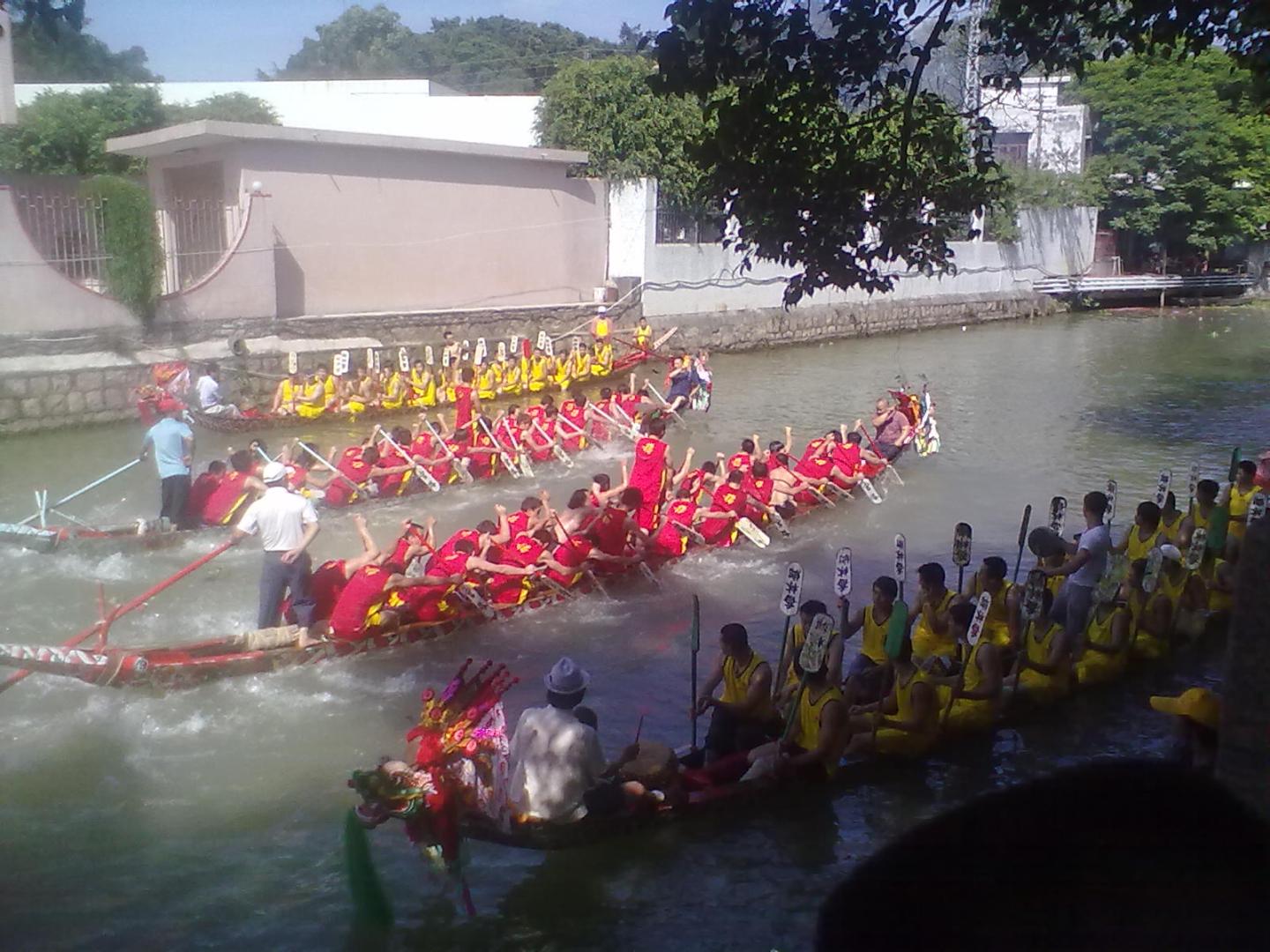
The commonest in Chenghai is the “headless mortar”: about eleven metres long and 1.1 wide, flat at both ends and hollow in the middle like a weaving shuttle, with no dragon head or tail and little painted work; people call it the cock boat, or the grasshopper leg. The hull is divided by wooden boards into benches for five pairs of paddlers, plus drummer, steersman and gong — thirteen to a boat. A pair of eyes is painted on the bow, in the manner of the old red-headed junks.
The Changli boatyard in Nanmei village, Lianhua town, Chenghai, still builds them by hand. The bottom is made of seven planks, which is why it is called the “seven-pair boat” locally: 8.6 metres long, 1.2 wide. The Lü family have been building them since the Wanli reign of the Ming, the Changli name is in its twentieth generation, and the yard still keeps six ancestral moulds for the bilge — set upright on the centreline at intervals, they fix the curve of the bottom, so it need not be measured out afresh each time.
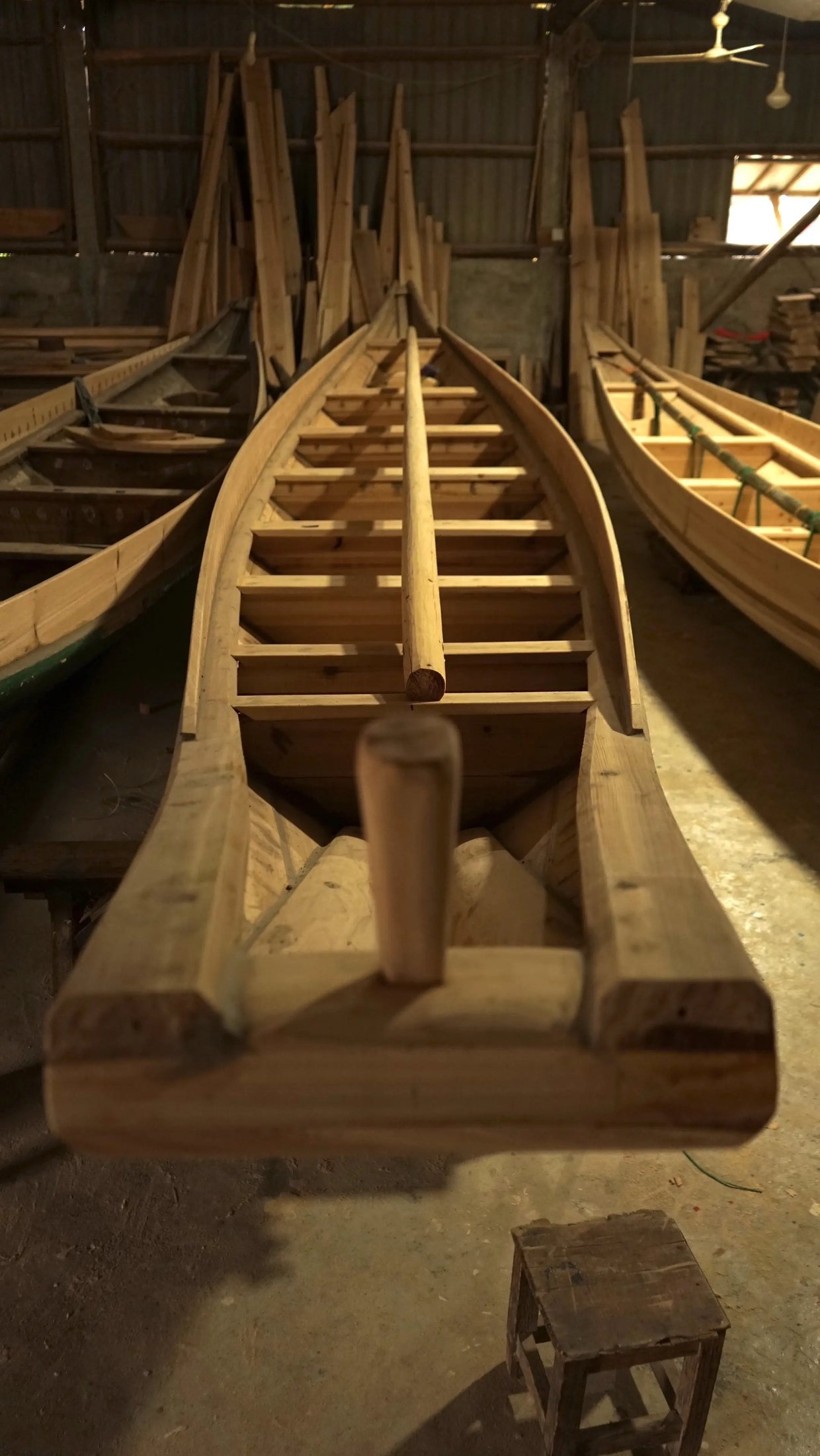
Timber is chosen and jointed by its grain; the flat-bowed boats are nailed plank to plank, the “hooked-head” boats nail the benches to the hull; once formed, the seams are filled, the surface sanded and tung oil applied. The holes at bow and stern for the grass rope are round at the head and square at the tail, for heaven round and earth square. A boat takes about fifteen hundred nails and twenty-odd days’ work, will last a dozen years with care, and needs freshening every year. Nine out of ten headless mortars in Chenghai and around come from this one yard.
The great rivers have another boat: twenty or thirty metres long, 1.4 to 1.6 wide, twenty or thirty pairs of paddles, the hull painted with fish and dragons. Raoping and Nan’ao have a painted-head boat, its bow made into a painted head, a size smaller than the big dragon boat.
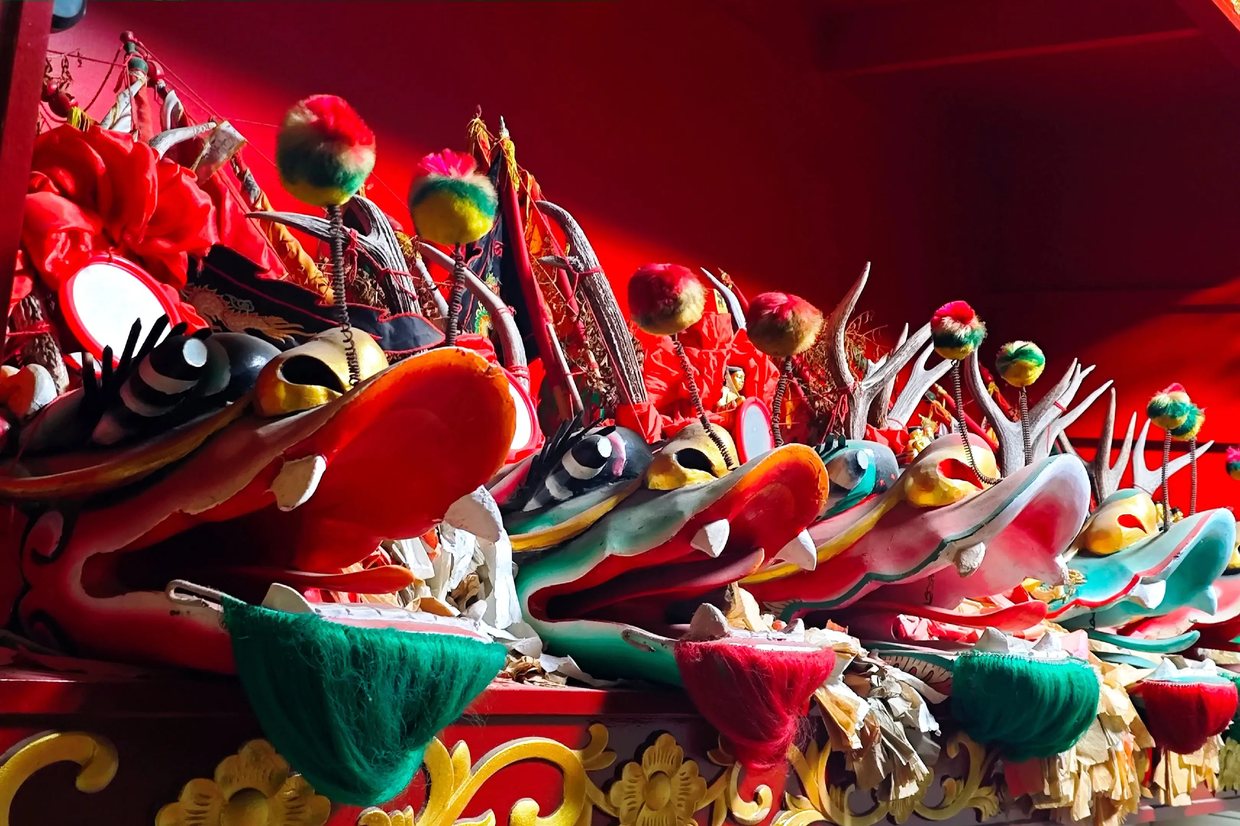
The painting too runs in schools. On Changli boats the belly is laid in blue and green, the stern painted with butterfly, hawk, dragon and phoenix, the bow with banana fan, gourd and ruyi sceptre.

The boats of Xianmei village, Linxi, Xiangqiao, Chaozhou, are another line again: fir, small and light, thirteen to a crew, with drumming, steering, bailing and paddling each to its own man.
Turning is a skill of its own. At Xiyang village, Huilai, the boats “hug the post”: the paddlers lean out and grab a wooden post in the water and use it to swing round in a narrow channel, which from a distance looks like a drift. Not every boat dares it — the water has to be deep enough, the boat short enough, the crew practised enough.
3. How a race runs
At Dutou village, Chenghai, the whole thing from start to finish follows the old rules.
Lots are drawn to pair boats off, and it is a knockout. Before the start, the stern of each boat is tied by a grass rope to a wooden post in the water, and the crews paddle the opposite way until the rope is taut. At the signal, a man by the post cuts the rope with a sickle and the boat shoots away — this is called cutting the grass rope.
A row of green bamboos is already planted in the water, both as the course and so that paddlers and spectators can measure the distance. The boat turns at the edge of the water, crosses to the far bank, goes round twice to four times, and comes back to the start to snatch the green.
The post at the start is called the Dragon Gate pass. On the last turn, someone sticks a red flower (pomegranate sprig) tied with red string onto the post. The first boat there — the drummer and the leading left paddler together — hooks the flower down and wins. Two boats are often a drumbeat or a paddle apart.
At Xianmei it is not called snatching the green but circling the dragon gate. The two boats first circle the banner in mid-river, then at the gong shoot off in opposite directions, turn at the coloured flags and come back at each other, three times over, and finally race for the “water signal” at the centre; whoever takes it first wins.
After the race, Chenghai people drink dragon-boat water and eat the dragon-boat meal.
4. When: one Chaoshan, several Double Fifths
Most places race around the fifth of the fifth month, but each has its own day. Spread the villages out and the season runs from the end of the fourth month to the end of the sixth.

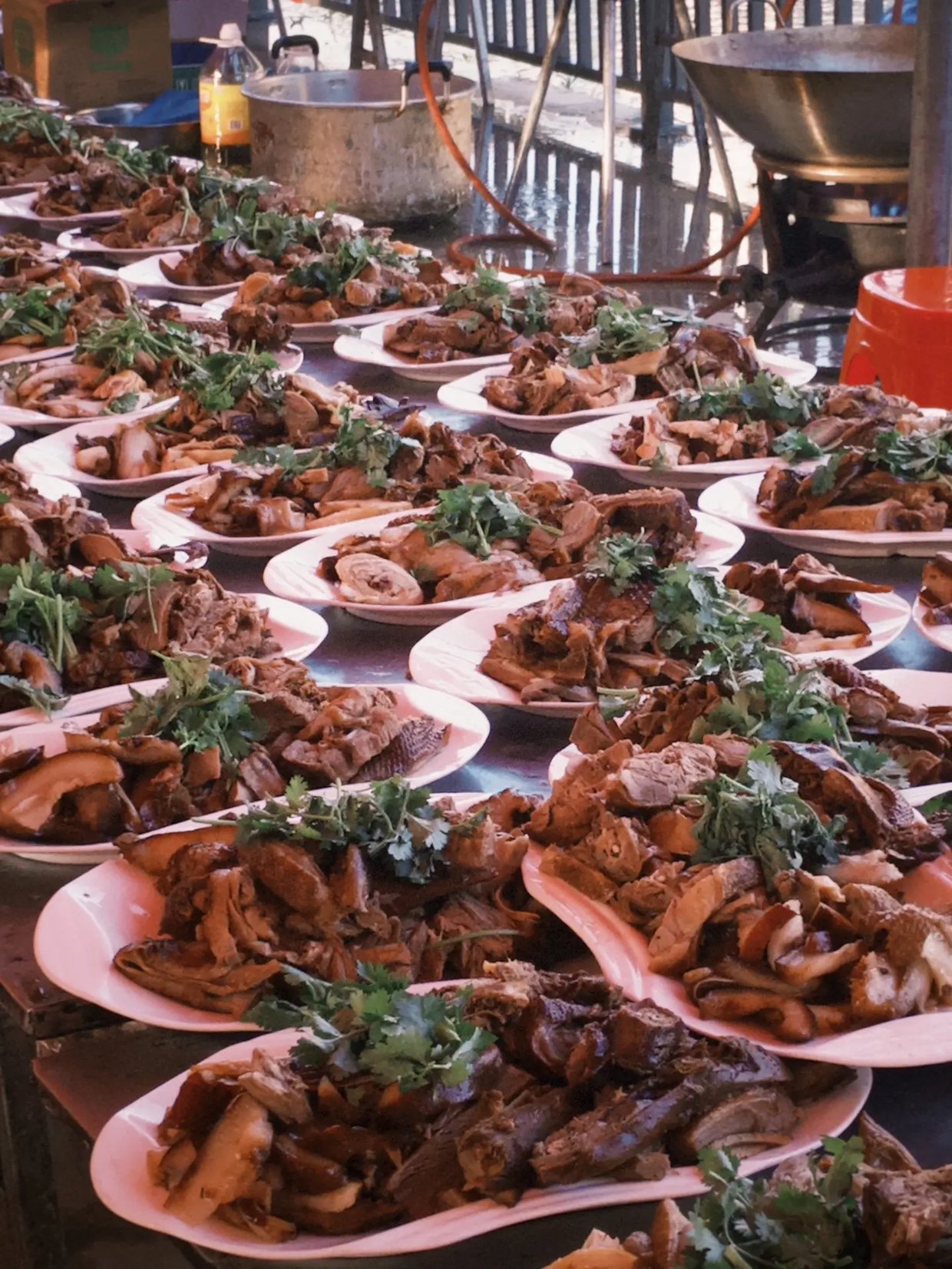
At Qiaotou, Tuojiang, Jinping, the boats go into the water on the twenty-eighth of the fourth month. After the offerings, those who carry them wash in pomegranate-flower water and together launch the boats into Hucuo pond. The races are on the fifth and the sixteenth of the fifth month; the sixteenth is the community day, the noisiest of the village year. Afterwards come the dragon-boat banquet and a lantern-riddle evening. Qiaotou’s racing began in the Xianfeng reign of the Qing, more than a hundred and sixty years ago, and entered the Shantou municipal heritage list in 2017.
Dutou village, Shanghua, Chenghai, does not race until the tenth. People used to add races of their own after the Double Fifth, which held up the farm work, so the village took counsel and moved the main racing to the tenth. On that day the villages for ten li around come, the embankments are packed, and racing runs from morning to dusk.
Boats are fielded by the “she”, the old community divisions. Shangdi lane, Xiadi lane, Shangren li, Xiadimei, Zilin, Xicuo, Xiyuan, East gate, North gate, Gangqian, Jiudun, Xindun, Nan’an, Beicuo and Fenggang li put out twenty boats between them, drawn into pairs and knocked out, racing from eight in the morning to five in the afternoon. Before the start each crew brings the incense of its own neighbourhood deity to the water; afterwards the crew carry the “chun sheng” baskets round the members’ houses, delivering the red flowers from the boats from door to door with gongs and drums, and each household receives them with gifts and gives something back.
In Jieyang each village “goes with the water” from the fourth month, choosing a day to launch, and that is the start of “Jieyang dragon-boat racing”, provincial-level heritage. On the Double Fifth itself there is racing on every stretch of the Rong and the Lian; in recent years the city has held a dragon-boat culture week around the festival, the main venue on the Nanpu fishing-song reach, with traditional boats performing in the morning and standard boats racing in the afternoon.
Village dates (2026)
In the date column the upper line is the lunar day and the lower the 2026 Gregorian date. Lunar days mostly stay the same year on year; the Gregorian dates have to be worked out afresh — in 2026 the Double Fifth is 19 June, the fifth of the fifth month.
Chaozhou · Xiangqiao (Linxi, Guantang)
| Village / reach | Day | Note |
|---|---|---|
| Xiangqiao · Linxi town, Xianmei village (Jinsha creek, Mianqian pool reach) | 3rd, 5th 06-17, 06-19 |
Thirteen-man boats, circling the dragon gate for the water signal |
| Xiangqiao · Linxi town, Xikou No.1 village (North creek reach) | 5th, 7th 06-19, 06-21 |
|
| Xiangqiao · Linxi town, Xikou No.2 village (North creek reach) | 5th 06-19 |
|
| Xiangqiao · Linxi town, Houyangdi village (Jinsha creek) | 6th 06-20 |
|
| Xiangqiao · Linxi town, Xikou No.4 village (North creek reach) | 13th 06-27 |
|
| Xiangqiao · Guantang town, Xiangxia village (North creek reach) | 9th 06-23 |
Chaozhou · Chao’an (Anbu, Caitang, Shaxi, Fengtang, Dongfeng)
| Village / reach | Day | Note |
|---|---|---|
| Chao’an · Anbu town, Liulong village (creek before Weize hall) | 5th 06-19 |
|
| Chao’an · Anbu town, Wenli village (Xintian creek) | 6th 06-20 |
Racing in inland channels |
| Chao’an · Anbu town, Guanlu village (Anjiang creek, Guanlu reach) | 3rd to 5th 06-17—19 |
|
| Chao’an · Anbu town, Qiaolin village (Anjiang creek, Qiaolin reach, front pool) | 2nd to 9th 06-16—23 |
|
| Chao’an · Anbu town, Xianxi village (from the army bridge to the Mianrong bridge) | 2nd to 9th 06-16—23 |
|
| Chao’an · Anbu town, Xue’er village (Xuelong creek) | 2nd to 9th 06-16—23 |
|
| Chao’an · Anbu town, Guolong (Guoyi neck bridge reach) | 2nd to 9th 06-16—23 |
Youth team friendly |
| Chao’an · Anbu town, Molong village (before the earth god) | 2nd to 9th 06-16—23 |
|
| Chao’an · Anbu town, Liulong (Longjiang road) | 2nd to 9th 06-16—23 |
Youth team friendly |
| Chao’an · Anbu town, Daqiao village (pool behind the temple) | 5th 06-19 |
|
| Chao’an · Anbu town, Meixiang village | 5th to 6th 06-19—20 |
|
| Chao’an · Anbu town, Lincuo village (old well bridge) | 5th 06-19 |
|
| Chao’an · Anbu town, Chencuo street (Anjiang creek) | 9th 06-23 |
|
| Chao’an · Anbu town, Zhuanglong village (creek before the village office) | 6th 06-20 |
Night racing from 7:50; fireworks and the presenting of the pennant |
| Chao’an · Caitang town, Hong’an district (Hong 1, 3, 4, 5, 6, Jin 1–4, Nanfang, Jindong) | 5th 06-19 |
Each village races its appointed reach on the same day |
| Chao’an · Caitang town, Hongqi village (from before the Longmei ye temple to the Qiwei pearl creek reach) | 1st to 7th 06-13—20 |
|
| Chao’an · Shaxi town, Jiali village (before the Xicuo ancestral hall) | 5th to 7th 06-19—21 |
|
| Chao’an · Shaxi town, Gaoxia No.2 village | 14th to 15th 06-28—29 |
|
| Chao’an · Fengtang town, Donglong village (Wanli village) | 5th 06-19 |
|
| Chao’an · Dongfeng town, Neipan village | 5th 06-19 |
Chaozhou · Raoping (Huanggang, Suocheng)
| Village / reach | Day | Note |
|---|---|---|
| Raoping · Huanggang town, Huanggang river (below the Fengjiang bridge) | 5th to 7th 06-19—21 |
Annual race of village crews; the “Fengjiang Cup” on the reach from Huanggang bridge to Nanmen bridge |
| Raoping · Suocheng town, Dacheng Suo | 1st to 5th 06-15—19 |
A dry dragon on land, not a race on water |
Shantou · Jinping (Tuojiang, Yuepu, Qishan)
| Village / reach | Day | Note |
|---|---|---|
| Jinping · Tuojiang subdistrict, Qiaotou community (Hucuo pond) | 5th to 16th 06-19—30 |
Launched on the 28th of the fourth month; the 16th, the community day, is the noisiest, with the dragon-boat banquet and a riddle evening |
| Jinping · Yuepu subdistrict, Gounan community (Langui lake) | 1st to 6th 06-15—20 |
Racing daily from 14:30, the main race at 15:00 on the fifth |
| Jinping · Tuojiang subdistrict, Judeng community (Xigang river, Judeng reach) | 4th to 5th 06-18—19 |
14:30—17:30 |
| Jinping · Tuojiang subdistrict, Jinlong community (Dagang river, Jinlong reach) | 5th 06-19 |
15:00—22:00 |
| Jinping · Tuojiang subdistrict, Gangmei community (Dagang river, Gangmei reach) | 5th 06-19 |
13:00—22:00 |
| Jinping · Qishan subdistrict, Zhonggong community (the big pond head) | 5th to 7th 06-19—21 |
Shantou · Chenghai (Shanghua, Xinan, Dongli, Guangyi)
| Village / reach | Day | Note |
|---|---|---|
| Chenghai · Shanghua town, Dutou village (inland channel) | 10th 06-24 |
Twenty crews, drawn into pairs and knocked out; extra racing once held up the farm work, so the main race moved to the tenth |
| Chenghai · Shanghua town, Shanghua district (big ponds of Henglong, Xiachen and others) | 5th 06-19 |
Henglong Liu lineage race; Xiachen village dragon-boat pond |
| Chenghai · Xinan town, Beishe village (Jiangjing channel) | 1st to 2nd 06-15—16 |
Inter-town invitational, ten crews |
| Chenghai · Dongli town, Nanpanzhou village (rear big pond) | 4th 06-18 |
Seven crews |
| Chenghai · Guangyi subdistrict, Longkeng community (village pond) | 5th 06-19 |
Starts 13:30 |
Shantou · Chaoyang (Mianbei, Heping, Jinzao)
| Village / reach | Day | Note |
|---|---|---|
| Chaoyang · Mianbei subdistrict, Houxi community (Guogong pond) | from the 5th 06-19—07-09 |
The seventieth meeting; recorded as early as 1874, listed as municipal heritage in 2025 |
| Chaoyang · Heping town, Tangwei community (Qianshan creek) | 5th 06-19 |
Run by the Ma Meizu ancestral hall |
| Chaoyang · Heping town, Xiazhai community (Lian river reach at Mazu square) | 6th 06-20 |
Ma Zhenxing hall youth race |
| Chaoyang · Jinzao town, Qianyang village (village-front creek) | 11th to 13th 06-25—27 |
Jieyang (Rongcheng, Puning, Jiedong)
| Village / reach | Day | Note |
|---|---|---|
| Jieyang · Rongcheng · Nanpu fishing song (south branch of the Rong) | 4th to 7th 06-18—21 |
Fourth dragon-boat culture week, eighteen traditional boats, a display race and standard-boat racing on the 20th |
| Jieyang · Puning, Nanxi town (Nanxi water country) | from the 3rd from 06-17 |
Eight traditional boats, with awning boats for touring the water country |
| Jieyang · Jiedong, Xichang town, Tanyang village | around the festival mid-to-late June |
Twelve traditional boats round the village channels |
Dates are set by each village’s ancestral hall and community head, and heavy rain and high water often force a change at short notice. The tables are put together from the 2026 festival programmes of the Chaozhou culture, broadcasting, tourism and sports bureau, the Xiangqiao district government, Shantou Ganlan TV (Jinping publicity) and Shantou Fabu; where a village has more than one race on one day, the red notice before the ancestral hall is authoritative.
One thing on the first of the fifth month is not on the water at all: at Dacheng Suo, Huanggang, Raoping, a paper dry dragon is carried through the streets and lanes, six days in six colours. That is provincial-level heritage, and has a page of its own: the dry dragon of Dacheng Suo.
5. Four things on dry land
First, the five auspicious plants. A bundle of mugwort, calamus, pomegranate flower, garlic and dragon-boat flower tied with red string is hung on the lintel and the door ring. In Tang and Song times Chaozhou was hot and damp in the fifth month with insects everywhere, and hanging these was meant to drive off pestilence; the smell of the herbs is sharp enough in itself.
Second, dragon-whisker water. Legend has it that the fifth of the fifth month is the dragon king’s birthday and the river water that day can cure illness, so it is called dragon-whisker water. Old people go down to the river at dawn, carry water home and keep it sealed for the family; some simply wash their faces in the creek. The old Raoping gazetteer says each household, at cockcrow, drew well water and steeped calamus and mugwort in it, enough for a day’s drinking, for the meaning of lengthening life.
Third, zong balls. Chaoshan zongzi are called zong balls and come in three kinds: corner zong, gardenia zong and pillow zong. Corner zong wrap glutinous rice and filling in bamboo or banana leaves; the kind with both sweet and savoury is called double-cooked, one end savoury and one sweet; the shop at Old Mama’s Palace in Shantou is the most famous, and there is a local riddle “Old Mama’s Palace zong balls — you only know once you have eaten”. Pillow zong come from the Fenghuang hills of Chaozhou: long and bar-shaped, nothing but glutinous rice. As the saying goes, “until you have eaten the fifth-month zongzi, don’t put away the torn padded coat”.
Fourth, gardenia cake. Gardenia fruit is pounded and strained, the juice mixed into glutinous rice batter with a little alkali, wrapped in muslin and steamed. The result is golden, with the scent of plants. It is not cut with a knife but sliced thin with a thread and dipped in white sugar. The fifth month is hot and damp, and the older generation say this cools the system.
Two smaller things: around Chenghai and Chao’an people eat pearl-flower greens at noon on the Double Fifth, and children are given fried egg with Rangoon creeper seed. Neither is a grand affair, but both turn up at this time every year.
6. Before you go
Racing is on open water with no cover on the banks. Bring water, wear a hat, and do not wear shoes that come off in a crush. On narrow embankments the crowd presses back; before you turn to photograph a boat, look behind you.
Do not step on a boat, do not sit on a dragon head, and do not step over a boat. Those rules are the same in every village.
Dates are set by each village every year and are not listed here. On the ground, read the red notice before the ancestral hall, or simply ask.
Sources
| Source | Body | Date | What it establishes |
|---|---|---|---|
| Customs chapter of the Chaozhou fuzhi | compiled by Zhou Shuoxun | Qianlong 27 (1762) | Mugwort and calamus in the door at Duanyang, pyramidal dumplings, bathing in a hundred-herb decoction, river water drawn as festival water, racing as of old |
| Jieyang xianzhi | compiled in the Qianlong reign | Qianlong | “River water is drawn and stored, called festival water, which keeps a long time without spoiling” |
| Chaoyang xianzhi | compiled in the Guangxu reign | Guangxu | “At the Double Fifth pyramidal dumplings are brewed … and some draw dragon-boat water and drink it” |
| Dongli zhi | Chen Tianzi | Ming | At the Double Fifth in Raoping “each household, at cockcrow, takes well water and steeps calamus and mugwort in it, enough for a day’s drinking, for the meaning of lengthening life” |
| Shantou Chenghai: an “unusual” dragon-boat race | Yangcheng Evening News | 2023-06-28 | Dimensions of the headless mortar and its crew of thirteen, cutting the grass rope, snatching the green at the Dragon Gate pass, why Dutou moved to the tenth |
| Dragon-boat custom in Chaoshan | Yangcheng Evening News | 2023-06-08 | The building sequence of the headless mortar, round head and square tail, more than sixty boats at Shanghua, the snatching rule |
| Dragons leap at Qiaotou, paddles moving for a century | Shantou Ganlan TV (Jinping publicity) | 2026-06 | Launch on the 28th of the fourth month, racing on the fifth and sixteenth, municipal heritage in 2017, the banquet and riddle evening |
| Jinsha creek: seven “fierce dragons” racing | Chaozhou Broadcasting TV | 2026-06 | The Xianmei “circling the dragon gate” format, fir boats, thirteen to a crew, the water signal as the prize |
| Dragon-boat racing in several parts of Chaozhou over the festival | Chaozhou municipal government | 2026-06 | Racing at Linxi and Guantang in Xiangqiao, at Anbu, Dongfeng and Caitang in Chao’an, and on the Huanggang river in Raoping |
| Five cities, one blaze on the water: Guangdong’s Double Fifth | Chaozhou Broadcasting TV | 2026-06 | Chaozhou racing widespread since the Ming, over six hundred years; skill rather than speed; lineage crews and the shared pork-and-rice meal after; the thirteen-man circling at Xianmei |
| Racing on the Rong river bank | Jieyang Broadcasting TV | 2026-06-23 | Eighteen traditional boats, twelve- and twenty-two-man standard boats, the post-hugging turn at Xiyang in Huilai, over four hundred years |
| Sweet on the tongue, fine on the water: the taste of the Double Fifth in Chaozhou | Chaozhou Daily | 2026-06-20 | The five auspicious plants, dragon-whisker water, how double-cooked zong balls are made, gardenia cake |
| “Eat zongzi and you’ll be strong”: more Chaoshan Double Fifth custom | Nanfang Plus | 2023-06-18 | The three kinds of zong, dragon-whisker water, pearl-flower greens, the sayings |
| Circling the dragon gate, taking the water signal: the craft of racing in Xiangqiao | Xiangqiao district government, Chaozhou | 2026-06 | Dates and reaches of the six villages: Xianmei in Linxi, Xikou No.1, No.2 and No.4, Houyangdi, and Xiangxia in Guantang |
| 2026 Chaozhou Double Fifth racing programme (published by Kan Chaozhou) | Chaozhou culture, broadcasting, tourism and sports bureau | 2026-06 | Dates and reaches for the Anbu villages, the Hong’an district of Caitang, Jiali and Gaoxia in Shaxi, Donglong in Fengtang, Neipan in Dongfeng, and Huanggang and Suocheng in Raoping |
| Racing, zongzi, garden fairs: Jinping invites you to the Double Fifth | Shantou Ganlan TV (Jinping publicity) | 2026-06-13 | Times and places for the six Jinping venues: Qiaotou, Gounan, Judeng, Jinlong, Gangmei and Zhonggong |
| 2026 Shantou Double Fifth racing timetable | Shantou Fabu (compiled by Shantou Bendibao) | 2026-06-16 | Dates and places for the seventieth meeting at Houxi in Chaoyang, and for Tangwei, Xiazhai and Qianyang |
| One Double Fifth, different ways of keeping it | Jieyang Daily | 2026-06-18 | The dragon-boat culture week from 18 to 21 June, main venue at Nanpu fishing song |
| Eighteen dragon boats race the Rong: Jieyang, home of the dragon boat, revives a century-old scene (Nanfang Plus) | Nanfang Plus | 2026-06-20 | Eighteen traditional boats, the Mianshu red dragon banner reading “who follows me”, the Nanxi launch in Puning on 17 June |
| Come to Guangdong for the Double Fifth: Chaozhou’s festival programme | Chaozhou Daily | 2026-06-11 | Linxi and Guantang in Xiangqiao from 17 to 27 June, the annual race on the Huanggang river, inland racing at Anbu, Dongfeng and Caitang |
| Our festival · Double Fifth: the fullest guide to watching the racing in Chaozhou | Chaozhou Wenming Net | 2023-06-22 | Dates and reaches for Xianmei, Liulong, Nanfang in Caitang, Xikou No.4, Zhuanglong (night of the sixth, fireworks and pennant) and the Raoping “Fengjiang Cup” |
| The bustle of the race at Dutou, Shanghua, Chenghai | 澄一员 (WeChat account) | 2026-06 | Twenty crews fielded by she; the deity’s incense brought to the water before the start; the chun sheng baskets carrying red flowers to members’ houses after |
| Young paddlers: a fourteen-year-old drummer at Shanghua, Chenghai, Shantou | Yangcheng Evening News (via Tencent News) | 2024-06-15 | Twenty boats at Dutou, thirteen to a boat, drawn into pairs and knocked out, the grass rope cut to start |
| Four hundred years on: twenty generations of dragon-boat builders in Chenghai, Shantou | Nanfang Plus | 2023-06-20 | The Changli yard at Nanmei village, Lianhua town; Lü Zhenbang the nineteenth generation; a bottom of seven planks, the “seven-pair boat”, 8.6 by 1.2 metres; six bilge moulds; more than nine tenths of Chenghai’s boats come from Changli |
| Four hundred years of a family building dragon boats in Chenghai | Yangcheng Evening News | 2024 | Lü Ming the twentieth-generation bearer; belly in blue and green, stern with butterfly, hawk, dragon and phoenix, bow with banana fan, gourd and ruyi |
| Oral history of a home village: four hundred years at Nanmei, twenty generations of builders | Shantou command post for Shenzhen paired assistance | 2023 | Thirteen to a boat (drummer, paddlers, bailer, steersman); about fifteen hundred nails; twenty-odd days a boat, good for a dozen years |
Each row above establishes only what is written in its own column.
Home › Customs › The ritual year › Double Fifth customs
Last revised: 3 November 2026