Feeding the dead and the Yulan assembly
The old gazetteer records of the Zhongyuan day only that “the offerings are of spirit money and paper garments” — paper money burned and paper clothes set alight, for those with no one to sacrifice to them. Chaoshan stretches the occasion out: the whole seventh month, villages taking turns to raise platforms and give away food, clothing and what is burned.

1. Who it is held for
The “orphaned” are the unattached dead — those with no descendants to offer incense on time. Chaoshan sent many abroad, and in the early years men who went overseas died over there with not even a tablet at home; in the seventh month’s offerings this layer weighs heaviest.
The offerings are not laid out to be eaten by the givers but to be given away, which is why the rite is called shi, “to give”. That is where it parts from household sacrifice: the family sacrifice honours one’s own ancestors, is set out in the hall or the lineage hall, and is run household by household; feeding the dead looks after those whom nobody sacrifices to, is pooled by village, temple or charity hall, and is spread over the platform and the ground below it.
The old gazetteer gives the occasion several names: in the seventh month the Yulan assembly is held, called feeding the dead, and also universal deliverance. Three names for one occasion, each naming a different face of it — the action, the title, the scope.
2. How the seventh month runs
| When | What is done |
|---|---|
| First of the seventh month | Worship at the “opening of the prison”. Every household sets food at the door with a stick of incense in each offering, and burns paper ingots and paper clothes. Popular saying has it that on this day the underworld lets the orphaned out to eat, and the feeding is counted from here. |
| Fifteenth of the seventh month | Zhongyuan. Households sacrifice to their own ancestors as usual and feed the dead on the same day; temples and nunneries hold Yulan assemblies with sutra chanting, and in the evening give out food and float water lanterns. |
| A day set by each village | The “main day of feeding”, that is the Yulan assembly, with the heaviest ritual. The day differs from village to village, and in some places is merged with the fifteenth — which is why something is being held somewhere all month. |
| End of the seventh month | Worship at the “closing of the prison”. The offerings are as on the first, and the orphaned are sent back; the month’s feeding ends here. |
In the last few days there is one more thing, called “planting the field”: meat, wine, cooked rice, incense and candles, silver paper and paper clothes are got ready, and people kneel at the door or by the roadside in the open country holding incense, bowing to the four directions and sticking incense into the offerings and along ditches and paths — planted out the way rice seedlings are, for the sense of sowing the field of merit wide and succouring every direction.
3. How the platform is built
The formal platform is built for the occasion, propped on bamboo and timber, and is called the orphan platform, or the painted orphan stage. Ksitigarbha is enthroned on it, a separate seat for the unattached is set at the side, and paper banners hang all round. Before the platform stands a paper king of the orphaned — blue-faced, fanged, taller than a man — to hold the altar.
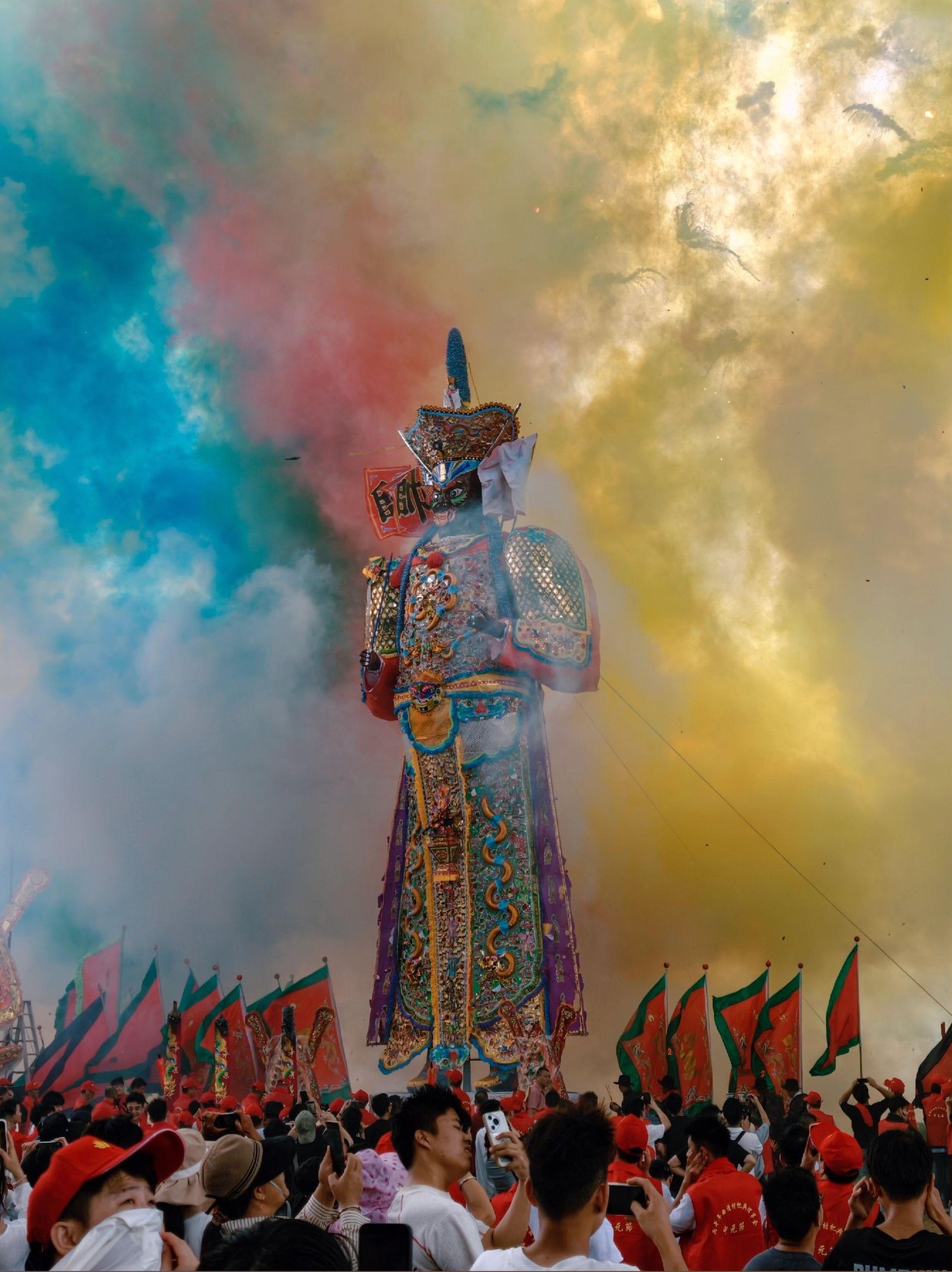
A paper boat of Guanyin loaded with silver paper often rides beside the platform. Tablets for adult men and women and for children are set on it as well, and the offerings brought for particular ancestors are labelled with names so that each is taken by name and nothing gets into a muddle. Where the offerings brought by each household will not fit, tables are set below the platform, borrowed by the organisers or brought by the families; in villages that do not hold a collective feeding, the offerings go at the door or the mouth of the lane.
4. What is set on the platform and below it
Rice, noodles, cooked rice, rice cakes, buns, sweets, oil and salt, paper clothing, paper money; the more elaborate set up mountains of gold and silver made of gilt and silver paper, all of it bright at night. In the old days the offerings piled up like hills, and people spoke of hills of fine noodles, of buns, of rice, of meat.
Once sacrificed, they are dispersed: divided among the poor, or thrown down for the scramble below; the paper images, paper clothes and paper money on the platform are burned together.

5. Opening the altar and the flame-mouth rite
The altar is opened by the vajra master. He strikes the hand-bell and leads the monks on either side in sutra and spell, inviting the buddhas and bodhisattvas down to the incense altar; chanting all the while, he changes the hand gestures and scatters tray after tray of peach-shaped buns and rice to the four directions — food thrown out for the dead, several times over. This part is the flame-mouth rite.
The explanation is that hungry ghosts have throats as narrow as a needle’s eye and fire in the mouth, so food comes to the lips and will not go down; the flame-mouth rite asks the buddhas and bodhisattvas to open their throats so that this one meal can be swallowed. The old gazetteer’s account — that on the middle of the seventh month the monks of each temple hold a Yulan assembly and chant, and in the evening give food at the flame mouth and float water lanterns to light the underworld — describes this passage and what follows it.
6. The scramble
When the service ends, what is on the platform is thrown down and the crowd below scrambles for it: scrambling for the offerings. Some come prepared with a “catcher” — a net bag bound to the end of a bamboo pole, held open to receive; others use a coat or a cardboard box; those with bare hands fare worst, grabbing one thing and dropping another, which is what the old line “drop the peach bun to grab a cake” is about.
What was given out in the old days was not only food: farm tools were among it, and these cannot be thrown, so they were written on tokens and dropped instead, a token being exchanged for the thing itself. For poor households the token mattered more than the opera, hence “those with money go to the play, those without come to scramble”. Old accounts say the scramble was strongest in Chaoyang, and not weak in Shantou port either, where a painted stage was once put up on a chosen day at the head of Shengping Road and monks of standing hired to chant for the universal deliverance.
7. The opera that night
On the main day most villages hire a Chaozhou opera troupe, or a wire-rod puppet show. The stage faces the platform, and once the gongs start the ground below fills up. The explanation is that yang energy presses down yin and good fortune scatters what is not auspicious; the audience is clear enough that this is not the same occasion as the processions of the first month.
8. The charity halls of Shantou port
In Shantou port the feeding was once run by charity halls. From the late Qing into the Republic, nine were founded in the city: Tongqing in the fourteenth year of Guangxu, Tongji in the twenty-first, Cunxin in the twenty-fifth, Yanshou in the thirty-first; then Chengjing she in the eighth year of the Republic, Hejing in the eleventh, Ciai in the twenty-first, Chengxin and Yanglian in the twenty-third. Tongqing later became Tongwen school, leaving eight.
Around the fifteenth of the seventh month each hall put up a great shed at its door and displayed the goods it had collected, lamps and candles burning; tickets were issued first and goods taken on the ticket. What could be had ran from quilts and padded clothes, bamboo baskets and carrying poles, pots, bowls, rice and noodles, to straw sandals, water cloths, towels, soap, lamps, candles and simple medicines. Whole families turned out to collect, taking from one hall and hurrying to the next, thousands of people running through the streets in a day — old accounts say it was not a fair, but more than a fair.
9. How it differs from merit-making at home
| Merit-making | Feeding the dead | |
|---|---|---|
| Who holds it | the bereaved household | village, temple or charity hall |
| For whom | the one of their own who has just died | those with no descendants to sacrifice to them |
| When | around the funeral, at length according to means | the seventh month, villages taking turns by district |
| Setting | an altar before the coffin, with crossing the bridge | an open-air orphan platform, with the scramble |
| How it ends | the altar is struck when the chanting ends | offerings thrown down, paper clothes burned |
Both call in monks or priests, both chant, both scatter food, and they are not the same thing: merit-making is run by household for one’s own dead who have someone to remember them; feeding the dead is run by district for those who have no one. The centre of merit-making is the altar before the coffin, and its most important passage is crossing the bridge; the centre of the feeding is the platform, with the king of the orphaned holding the ground in front and the scramble dispersing the offerings below.
10. Beyond the seventh month
Wherever Chaoshan people have gone, the occasion has gone with them. The Yulan assemblies of the Chaozhou community in Hong Kong have been held for more than a century, in over sixty neighbourhoods across the island, Kowloon and the New Territories, each running its own; they entered the national list of intangible cultural heritage in 2011, nominated by the Hong Kong Special Administrative Region. There peace rice is given out, blessed goods bid for, and offering opera performed — the same pattern as the scramble and the opera here. Chaozhou communities in Malaya, Thailand and Indonesia still hold them too.
Common questions
- Is the feeding held only on the Zhongyuan day?
- No. It is counted from the “opening of the prison” on the first of the seventh month and closed with the “closing of the prison” at the end of the month, and something is being held all month; besides the fifteenth, each village has a day of its own, called the main day of feeding.
- Why is a king of the orphaned set before the platform?
- The story is that when the feeding is held, hungry ghosts gather from the four directions and fight over it in disorder, and even Guanyin cannot stop them, so she takes the form of a ghost king to overawe them; that is why every feeding has one made and set before the platform to hold the altar.
- What is scrambled for?
- The offerings on the platform. When the service ends the officiant throws them down and the crowd below catches them in a “catcher” (a net bag on the end of a bamboo pole), or in a coat or a cardboard box; what you catch is yours.
- What is the difference between the feeding and merit-making?
- Merit-making is held by a bereaved household for the one of their own who has just died, around the funeral, with an altar before the coffin; the feeding is held by a village, temple or charity hall for those with no descendants, in the seventh month, on an open-air platform.
- What is “planting the field”?
- In the last days of the seventh month, as the gate of the orphaned is about to close, each household gets ready meat, wine, cooked rice, incense and candles, silver paper and paper clothes, kneels at the door or by the road holding incense, bows to the four directions and sticks incense into the offerings and along ditches and paths, planted out like seedlings, for the sense of sowing the field of merit wide and succouring every direction.
- What finally happens to the offerings?
- Once sacrificed they are dispersed: divided among the poor, or thrown down for the scramble; the paper images, paper clothes and paper money on the platform are burned together.
See also: The ritual year (the festivals of the year); Funeral custom in Chaoshan (merit-making and crossing the bridge); feeding the dead, Yulan assembly, orphan platform, king of the orphaned, flame-mouth rite, scrambling for the offerings, merit-making, crossing the bridge (glossary); the glossary; Sources and evidence.
Sources
The Jiaqing Chenghai xianzhi, customs (monks of each temple holding a Yulan assembly in the middle of the seventh month, food given at the flame mouth in the evening, water lanterns floated to light the underworld); the Qing Haiyang xianzhi (in the seventh month the Yulan assembly is held, called feeding the dead, also universal deliverance); the Qianlong Puning xianzhi (at Zhongyuan ancestors are sacrificed with spirit garments, wine and food); accounts of the nine charity halls of Shantou port and of the tickets issued for the feeding on the fifteenth of the seventh month; a first-hand record and photographs of Dashi ye at the Zhongyuan feeding in Nanyang village, Guiyu; the Yulan assemblies of the Chaozhou community in Hong Kong (project description in the national list of intangible cultural heritage). Accessed 29 October 2026.
Home › Customs › The ritual year › Feeding the dead and the Yulan assembly
Last revised: 3 November 2026