Chaozhou gece
Gece are long stories sung in the Teochew dialect, seven characters to a line and four lines to a group. Most of the people who sang them were not literate. They held the booklet in their hands and sang off the page.
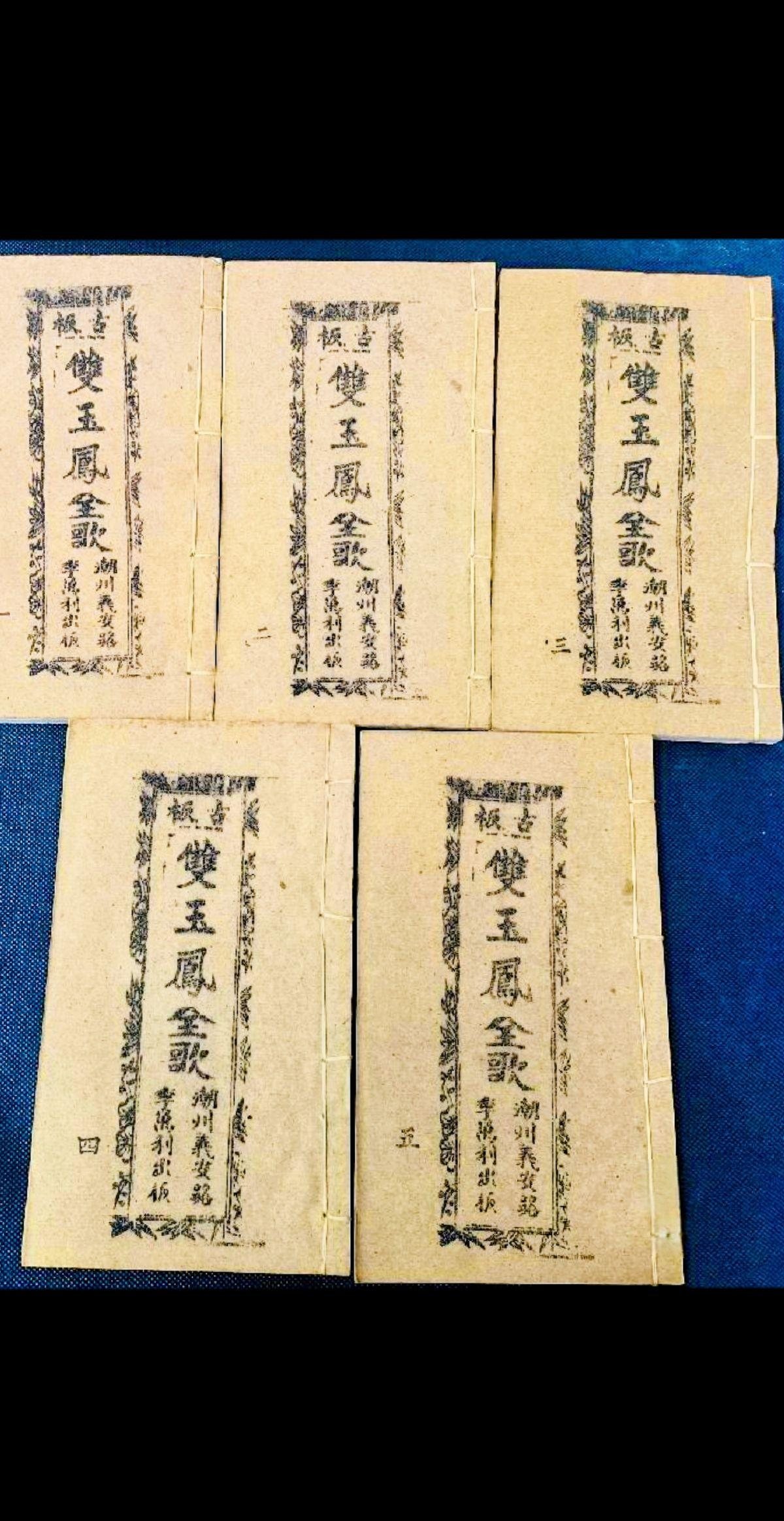
What it is
‘Chaozhou gece’ means both the printed libretto and the form of narrative singing done from it. In June 2008 it entered the second national list of intangible cultural heritage, as an expanded item, code Ⅴ-34, serial number 270, category quyi (sung storytelling), with Chaozhou as the applying region.
The form belongs to the shi-zan family of storytelling: seven-character lines for the most part, four lines to a stanza, the first line setting the rhyme, the rhyme changing from stanza to stanza, chanted with the bare voice and no instrument. Xiao Shaosong of South China Normal University puts it concretely — lines mostly of seven characters with ten-character lines mixed in, and a vocal mode or tune that stays relatively fixed. The rules were not gece’s own invention. Through the Ming and Qing the shi-zan family rose, and baojuan, tanci and muyushu all went the same way.
How it is sung
No instruments, no fixed score; the tune follows the words. The singer holds the booklet and sings looking at it. Most quyi forms are passed on by mouth. Gece is passed on by the book.
What four lines look like can be seen in a passage from Qin Fenglan:
淡淡青天不可欺,舉頭三尺有神明。
善惡到頭終有報,天理報應無差池。
The pale blue heaven cannot be deceived; three feet above the head there are gods. Good and evil come to their reckoning in the end; heaven’s accounting does not miss by a hair.
Seven characters to a line, four lines to a group. Lines one, two and four rhyme; the third does not. Dialect characters are written into the libretto as they are spoken — nan (we), m (not), i (he) are not turned into literary Chinese. Read out, it is speech.
Where it came from
There are three accounts of its origin, and scholarship has not settled on one.
One says tanci came into Chaozhou. Xiao Yaotian, a Teochew scholar in Singapore, wrote in Chaozhou Drama and Music that after tanci was introduced it was sung in Teochew pronunciation and called gece, and that it was already widespread in the Qianlong and Jiaqing years.
One says it grew here. Gece came up out of Teochew folk song, She song and local drama, and only later took its subjects and its structure from baojuan, tanci and muyushu.
One says it is imported libretto made local, the view of the scholar Wang Shunlong. He noticed that gece is sung with no instrumental accompaniment at all, more ‘primitive’ than other quyi forms, and reasoned from that its history ‘may be shorter and shallower than one would expect’.
Xiao Shaosong takes the middle: the large setting is the rise of shi-zan storytelling in the Ming and Qing, the small setting the flourishing of Teochew folk song and drama. Gece, on this reading, is Teochew people chanting Jiangnan tanci and Guangzhou muyushu in local speech and local tune, formed around the early Qing.
One piece of evidence is firmer than any dating. Gece runs four lines to a group, first line setting the rhyme, rhyme changing between groups — and that matches neither tanci nor muyushu. A libretto can be copied over from somewhere else. A format cannot.
Printed editions and bookshops
Gece was merchandise, and it was printed. In front of the old prefectural yamen in Chaozhou — the north end of today’s Yi’an Road — in the less than one hundred years from the late Qing to the last years of the Republic, nearly twenty bookshops printing gece gathered.
The largest was Li Wanli, opened about the Xianfeng and Tongzhi years. Its founder Li Guodian began by cutting and printing at home in Tongren Lane off Zhongshan Road, blocks and stored blocks both kept in the house. As the business grew, his son Li Siming opened a shop at the mouth of the Four Scholars Pavilion lane on the prefectural city main street, today the north section of Taiping Road. It was called the Li Wanli shop, and later moved to Fuqian Street, north of the mouth of Tie Lane on present-day Yi’an Road. Block-cutting, proofreading, printing, binding and selling ran as one line, and the goods went out to Haifeng and Lufeng, to Fengshun and Dabu, and to Yunxiao and Zhao’an in Fujian.
The house later split into Wanli Old Shop, Wanli Shengji and Wanli Chunji, and three generations of the Li family lived off the trade. In the 1950s, under joint public-private operation, Li Wanli joined a picture-mounting workshop and stopped printing.
The Chaozhou collector Xu Shengjie has been gathering gece for more than twenty years. He says books can be found from Teochew villages out to Yunxiao in Fujian and to Haifeng and Lufeng in Shanwei.
Who sang it
The singers were women. Hence the two names it carries: ‘Chaozhou women’s writing’ and ‘the Teochew woman’s textbook’.
Between 2011 and 2015 Liu Wenju of Hanshan Normal University led a research team around the Chaoshan area looking for people who could sing gece and taking oral histories. They interviewed forty — thirty-five women and five men. In 2017 the work was compiled as Chaoshan Women’s Oral History: Chaozhou Gece.
A few of those lives show the setting. Weng Huihua, born 1939 in Shantou, lost both parents as a child and began learning from an elderly neighbour at fourteen; she farmed by day and sang at night by a kerosene lamp, and being illiterate, the characters she knows came from gece. Chen Jingshan, born 1927 on Haishan in Raoping, said there was nothing at all in those days, and that it was from gece she learned who was good and who was bad. Li Sulan, born 1917, was close to a hundred when interviewed.
People still sing it. Mai Weichun teaches primary and middle school pupils in Chaozhou, and her line is to put new wine in the old bottle — to write new text for Chaozhou gece.
What is sung
There is adapted material and original material, and early on the adapted kind was the majority, drawn from chapter novels, huaben stories, tanci, muyushu and Chaozhou opera. The themes run with popular literature: punishing evil and rewarding good, keeping the ethical order, loyalty and filial piety, chastity and righteousness.
Titles include Qin Fenglan, Qin Xuemei, Fan Lihua Conquers the West, Five Righteous Women, The Two Parrots, Twelve Widows Conquer the West, The Six Wonders Formation, The Jade Fish, The Eight Immortals Picture, The Double Phoenix Hairpin and The Four Beauties.
Women take the first lead in a high proportion of them. Xiao Shaosong singles out one type: there are an unusual number of bandit women — Wang Yuxian in The Jade Fish, Wang Eji in The Eight Immortals Picture, Guo Guimei in The Double Phoenix Hairpin, Hu Meiying in The Four Beauties — holding a mountain, good with weapons, and willing to step in when someone is in trouble.
The Yang family saga was reworked when it came into Chaoshan. In The Two Parrots the marshal who breaks the Liao is She Taijun, with Yang Ye as her vanguard. Yang Ye carelessly loses the command flag, and She Taijun would have him beheaded under military law. The sung lines run: ‘The lady hears it and her anger strikes the sky, / against my military law the crime admits no argument; / you were vanguard and did not look to it, / the barbarian troops raided the camp and you did not know. / Order the attendants to bind him, / march him out for execution, the crime deserves death.’ In the novel She Taijun holds no such position.
Between one area and another
The printing was in the prefectural city. The cluster of bookshops at the north end of Yi’an Road and along Fuqian Street was the source, and the goods went out to Haifeng and Lufeng, Fengshun, Dabu, Yunxiao and Zhao’an.
The singing was scattered through the countryside. Among the people the team interviewed, Weng Huihua was in Shantou and Chen Jingshan on Haishan in Raoping; in Chaozhou itself it now depends on teaching of the kind Mai Weichun does.
Whether Jieyang has any dedicated record of transmission, nothing was found. Which of the three cities sings more, and whether the manner differs between them — the material at hand is not enough for comparison. Only the distribution is listed here.
Related
For dialect and its sound notation, see dialect and performance. Music in the same storytelling system: Chaozhou music. The list of lanterns recorded in a mixed song like Hundred Screens of Lanterns: Chaozhou lanterns.
Sources
Southern Daily, ‘Chaozhou Code ⑥ Chaozhou gece: a women’s art, or the discipline of an age?’, 21 October 2021, with interviews of Xiao Shaosong and Liu Wenju; the ‘Chaozhou gece’ database at Shantou University Library; the item page for gece (Chaozhou gece) at the China intangible cultural heritage website; China Youth Net, ‘How much do you know about Chaozhou’s intangible heritage’; the national ICH list on the Chaozhou municipal government portal.
Home › Heritage › Heritage list › Chaozhou gece
Last revised: 6 November 2026