Guangji Bridge
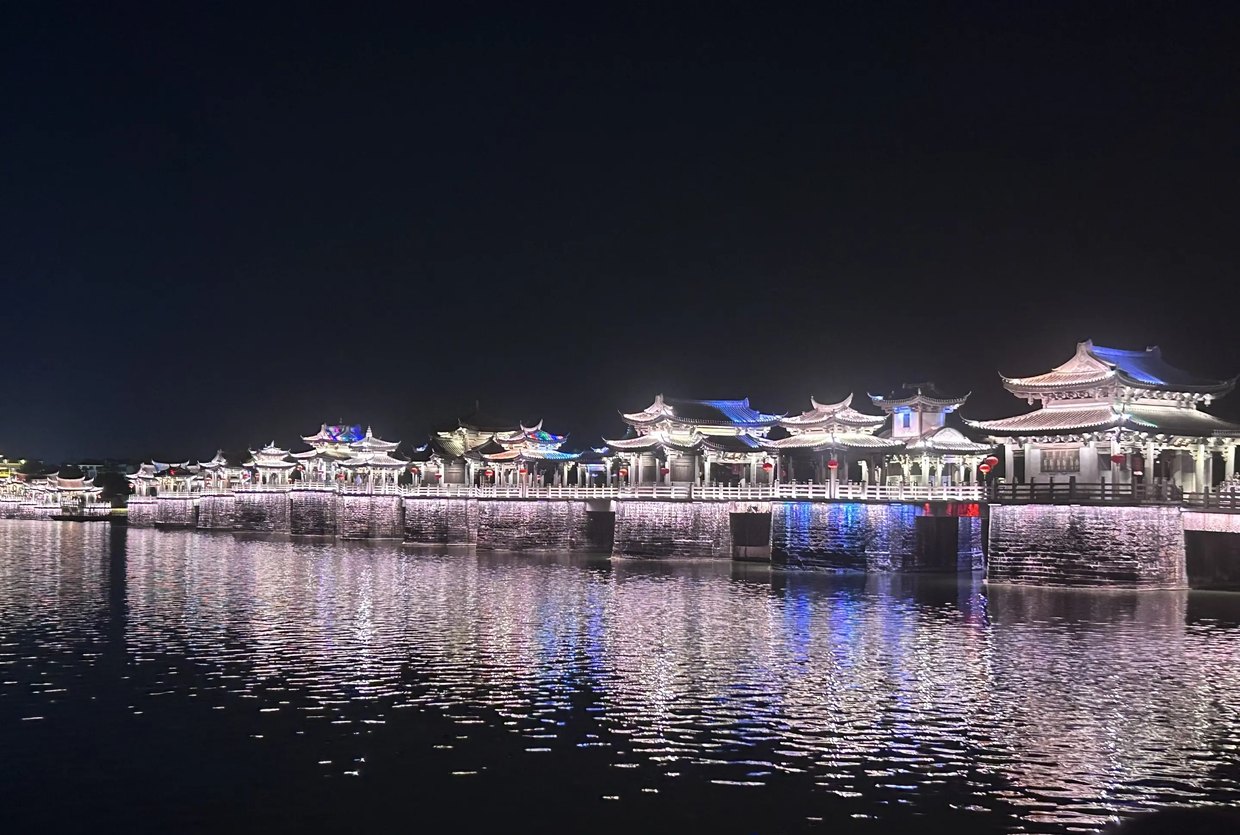
Three kinds of bridge in one span across the Han River: stone beams, arches on the piers, and a pontoon of eighteen boats in the middle that is opened and closed every day.
In one line A bridge that is alive: the pontoon section is taken apart and put back every day, and that process, not the stonework, is the thing to watch.
Look for The twenty-four pavilions · the boats closing and opening · Guangji Tower on the west bank
What to see in it
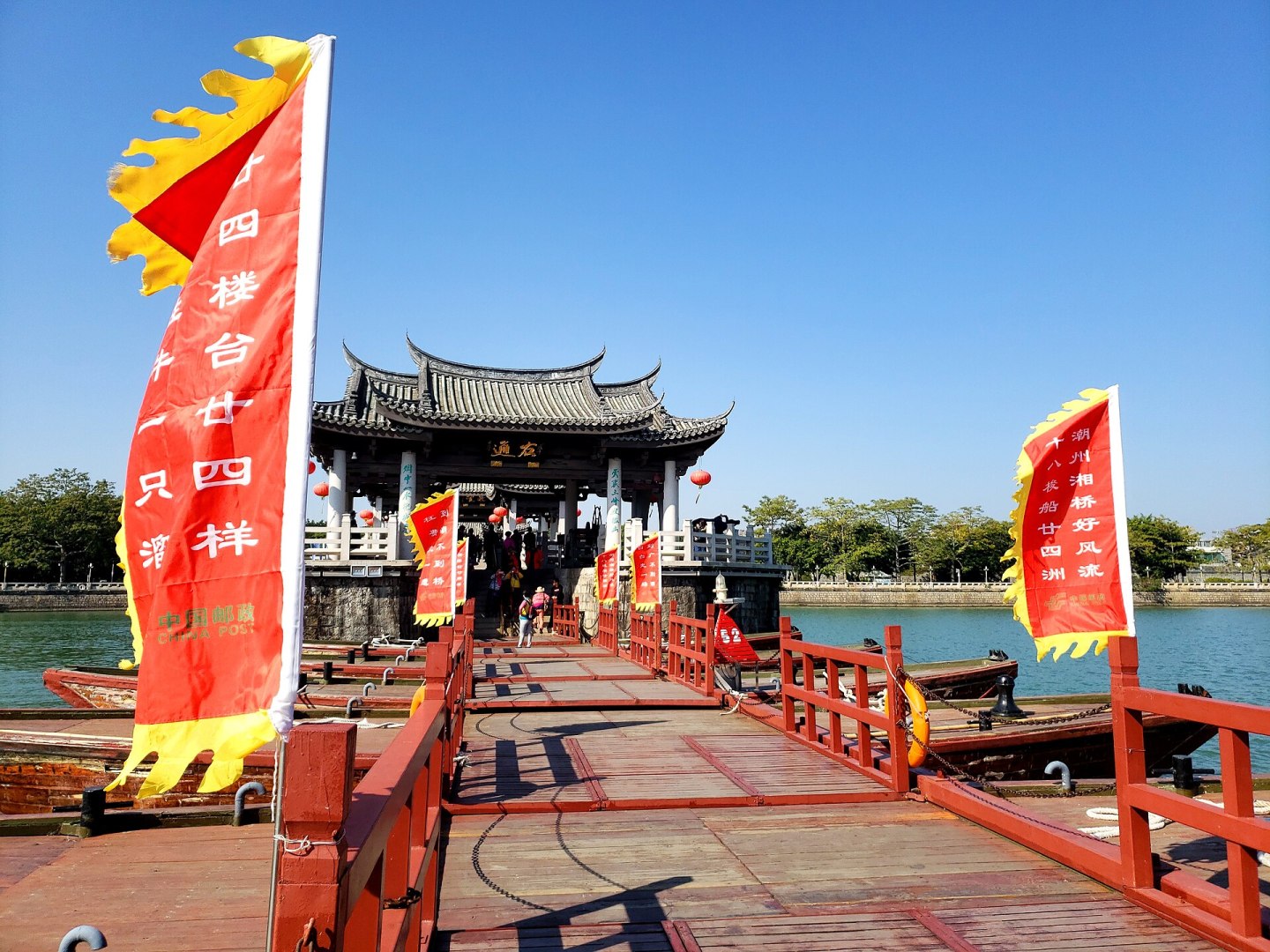
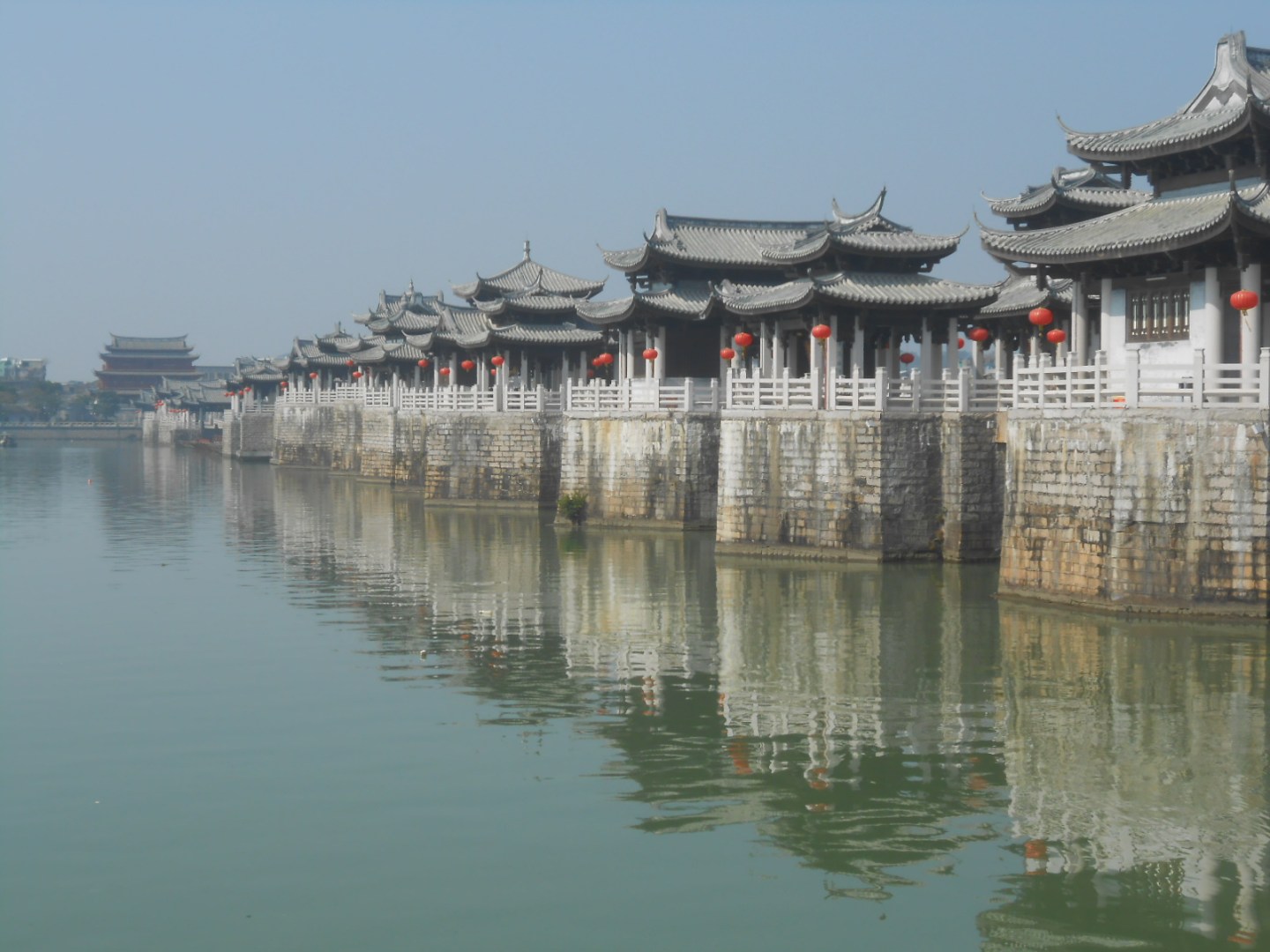
Three bridge types joined into one: stone beams at both ends, arches on the piers, and eighteen shuttle boats in the middle. The boats close so people can cross and are taken apart so vessels can pass — that opening and closing is what separates it from any other stone bridge. Twenty-four pavilions stand on the piers, so one walk takes you through several ways of building a bridge at once. The iron oxen at the bridgehead are old flood-suppressing pieces; there used to be two.
History
The bridge was begun in the Qiandao era of the Southern Song. Two dates for the start are both in circulation: the sixth year of Qiandao, 1170, and the seventh, 1171. It was first called Jizhou Bridge, then Kangji Bridge, Dinghou Bridge and Jichuan Bridge; locally it is known as Xiangzi Bridge.
The difficulty was the middle. The Han River runs fast here and a stone pier will not stand, so piers and stone beams were built at the east and west ends and a hundred metres left open in between, spanned by a pontoon of shuttle boats — walkable, and openable to let ships through. That combination of beam bridge and pontoon led the bridge engineer Mao Yisheng to call it the earliest open-and-close bridge in the world.
It was listed in January 1988 in the third batch of Major Historical and Cultural Sites Protected at the National Level. In the later twentieth century the shuttle boats were removed and the middle rebuilt as a three-span steel frame on high pile caps; between 2003 and 2007 it was restored and the Ming form recovered.
Structure and craft
- Three sections: a stone beam bridge in the west, the pontoon in the middle, a stone beam bridge in the east; each beam section is pier, beam and pavilion together.
- Twenty-four piers, twenty-four pavilions: a pavilion on each pier, no two alike — one crossing is a survey of how Chaozhou builds a pavilion.
- Boats that open: eighteen wooden boats lashed side by side into a walkway, taken apart on schedule to let vessels through. The timetable is the bridge’s working day.
- Iron oxen: cast to hold the water down; the rhyme says “two shiny oxen, one slipped away”, and one remains.
People
The successive chief builders are recorded in the prefectural and county gazetteers. Ding Yunyuan, a Southern Song prefect of Chaozhou, added four piers to the west section, an act also recorded on the Yunyuan Pavilion at the Han Wengong Shrine. The rhyme that attaches the bridge to Han Yu and to his nephew Xiangzi is legend, not a building record.
What to look at
- The pavilions: walk them one by one and look at the timber frames and the inscribed boards.
- The pontoon closing and opening: a working structure, not a stage set.
- Guangji Tower on the west bank: built in 1370, the first of the seven old city towers of Chaozhou, and part of the same composition as the bridge.
Visiting
The opening and closing runs to a fixed schedule, adjusted for water level and holidays; check the official notice before setting out. The deck is narrow and numbers are capped on holidays. To see the pontoon clearly, stand on the west bank for the whole view rather than walking onto the bridge.
Tickets and hours Ticket: bought at the bridge for the deck; the banks and the tower outside the east gate are open freely | Hours: open by day, closed after dark | The demonstration times move with water level and holidays; read the notice on the day | No booking needed.
Bridge and city
Guangji Bridge is not a bridge on its own; it belongs with the Guangji gate tower on the east bank. The tower was built in 1370, the third year of Hongwu, and was formerly called Guangji Tower and Hanjiang Tower, locally the East Gate Tower — first of the seven old city towers of Chaozhou. The bridge runs out from under the gate and across the Han River: city, gate and bridge on one axis, which is the frame of the old city.
The Han River was the trunk waterway of eastern Guangdong. The beam-and-pontoon form was not only a saving: it was about being able to open. The eighteen boats of the middle section close by day for people and are taken apart on schedule for ships. The rhyme sings “eighteen shuttle boats, twenty-four piers, twenty-four pavilions in twenty-four manners”, and what it describes is that order, which can be opened.
Iron oxen and the water
Oxen were cast on the bridge to hold the water down, and the rhyme goes on, “two shiny oxen, one slipped away” — of the two, one was carried off by the flood, and one is left. A water-quelling beast is common on old Chinese bridges, but that one was actually washed away is a fair measure of how hard this river runs.
Built and rebuilt
The bridge dates from the Qiandao era of the Southern Song and was repaired in every dynasty. In the later twentieth century the shuttle boats were removed and the middle rebuilt as a three-span steel frame on high pile caps; only the restoration of 2003 to 2007 brought back the Ming form and put the boats in the water again. What you see today as the old bridge is a documented reconstruction twenty years old, which is worth knowing while you are standing on it.
How to look at it
- Start on the west bank for the whole view: the relation of beam, pontoon and beam reads at a glance.
- Then walk the pavilions: twenty-four of them, all different, a catalogue of Chaozhou pavilion building.
- Leave time for the opening: the taking apart and closing is the only moving exhibit on the bridge, and more direct than any notice board.
On the same trip
- Paifang Street — cross the bridge and you are in the city; Taiping Road begins inside the east gate.
- Kaiyuan Temple — in the same old city, ten minutes on foot.
- Jilue Huang Shrine — also in the old city, and can be joined into half a day.
The order is yours to work out from the map and the hours; this only says what lies on the way.
In the routes: six itineraries place it in the plan, the half-day, one-day, two-day, three-day, four-day and five-day.
Note on sources
- The year of foundation and the structure come from the Chaozhou municipal government and from China Qiaowang, “How Chaozhou became a model in protecting and using its heritage”; and from Nanfang Net, “Nine national protected sites in Chaozhou”.
- The rhyme “eighteen shuttle boats, twenty-four piers” and the restoration of 2003–2007 come from National Geographic Chinese, “Tasting the old city: Chaozhou”.
- Mao Yisheng’s description of it as the earliest open-and-close bridge in the world comes from the Chaozhou municipal government portal.
Home › Travel › Chaozhou › Guangji Bridge
Last revised: 4 November 2026