Fenghuang mountain
The mountain in the north of Chao’an, and the core district of Fenghuang dancong tea. What you go up for is the tea terraces, the cloud and the heavenly pool — not monuments.
In one line Look at the mountain and the tea, not at monuments; the country only changes above 1,300 metres.
Look for Meadow above 1,300 metres · the heavenly pool · tea terraces and the making of tea

What to see, culturally文化看点
The core district of Fenghuang dancong, where the mountain only changes character above 1,300 metres: tea terraces, cloud and the heavenly pool. What you look at is the relation between the mountain and the tea — dancong’s aroma types are sorted bush by bush, and the old bushes are in the villages, not in the scenic area. Monuments are not this mountain’s business.
What it is是什麼
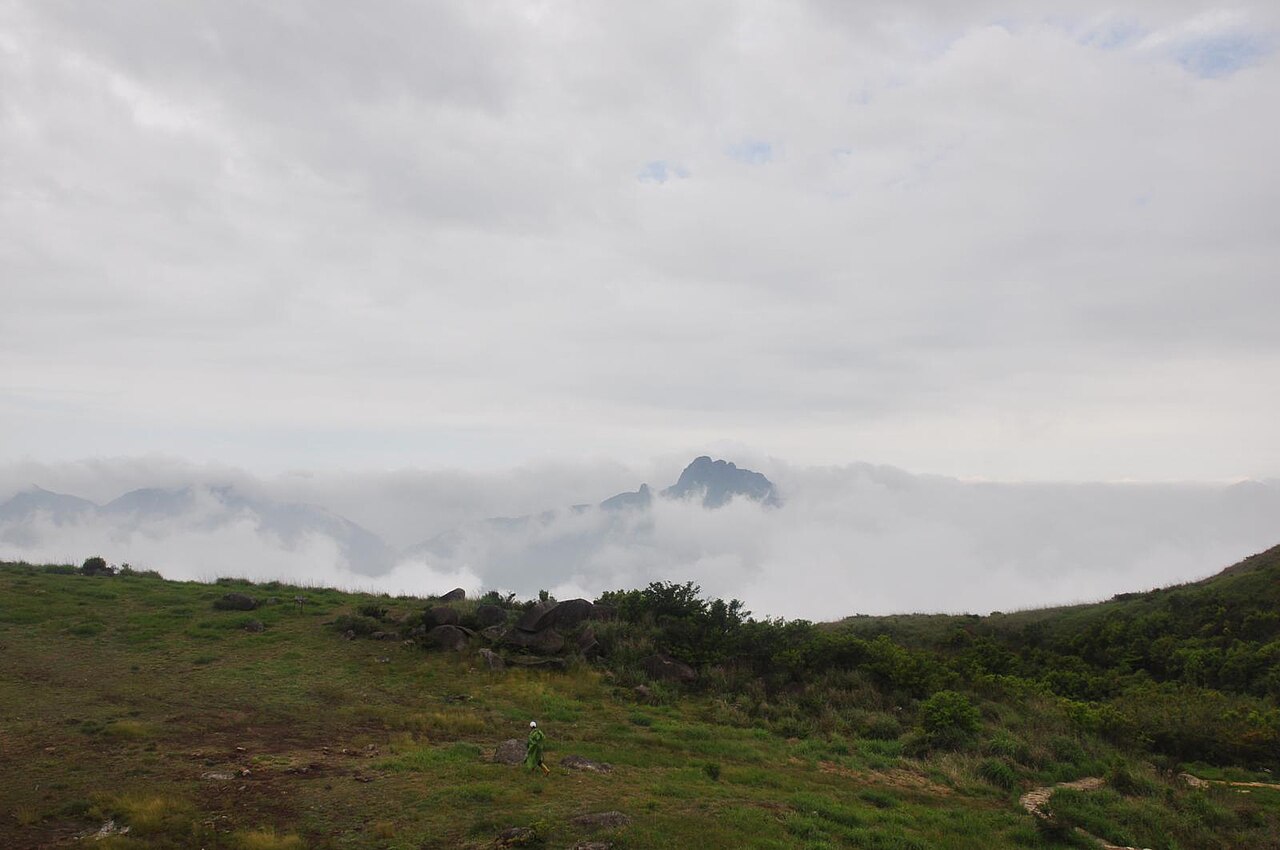
Fenghuang mountain lies around Fenghuang town in Chao’an district, the south-western spur of the Daiyun range; the massif is Yanshanian granite and acid volcanic rock. The main peak, Fengniaoji, is 1,497.8 metres, the highest point in the Chaoshan area, which is why it is called the roof of Chaoshan; the second peak, Wudong mountain, is 1,391 metres.
It is the core district of Fenghuang dancong tea. The leaf used for Chaozhou gongfu tea is properly Fenghuang tea, and this is where it comes from. Dancong has many named varieties and a tangled set of aroma types, commonly sorted into ten; ‘duck-shit fragrance’ is the one most widely repeated — an unlovely name for good tea.
On the mountain is the Fenghuang heavenly pool, at 1,325 metres, with about 40,000 square metres of water: a high lake formed in an old volcanic crater. A tea estate was run here around 1958. In 2010 the pool was listed among the eight new sights of Chaozhou as ‘the finest heavenly pool south of the country’.
The mountain road has many bends, and the drive takes longer than it looks on the map.
The mountain and the tea山与茶
Tea on Fenghuang mountain is not a matter of the last few decades. Shiguping in these hills is one of the birthplaces of the She people, and locally they say that ‘before there was a Raoping county, there was Shiguping’; the She planted tea before the Han Chinese took it up on any scale. A rock inscription reading ‘Song tea’ survives in the hills, meaning that tea bushes were already here in the Song — an old record.
Today’s tea hills are terraces planted in rows, and at the spring picking the whole slope is full of people. The bushes around Wudong are mostly old, and the oldest single bushes are picked separately, with a vocabulary and a price to themselves.
What to look at看什么
- The meadow: above 1,300 metres the slope is continuous grass with no tall trees, and walking is open. When the cloud comes up you are standing above the cloud line.
- The heavenly pool: a lake caught in an old crater, flat in good weather. Fog comes up fast; do not count on seeing it.
- The tea terraces: planted in rows up the slope, with picking to watch in spring.
- Tea making: sunning, withering, turning, killing the green, rolling and baking — part of the sequence can be seen at a grower’s house.
Visiting参观提示
The road bends a great deal and motion sickness is common; bring something for it. The spring picking, around Qingming, is the busiest time and the worst for traffic. It is colder up here than in town — bring a jacket. Buy tea by how it tastes, not by the name of the variety.
A note說明
Fenghuang mountain is not a protected cultural relic site. It is introduced here as geography and produce only, and no ‘scenic rating’ is given.
Tickets and opening Tickets: none; the tea terraces on the mountain are run separately. Opening: all day, with heavy traffic and narrow road in the spring picking season. No booking needed.
Related entries对应词条
Gongfu tea, and Chaozhou dishes and snacks.
On the same trip同城顺路
- Daoyun tower — also in the north, but a different direction; better split over two days.
- The Han Wengong shrine — a stop on the way back down to town.
- Guangji bridge — you are back in town when you reach it.
Settle the order yourself by the map and by your own hours; this only says what falls on the way.
Sources来源
- Main peak Fengniaoji at 1,497.8 m, second peak Wudong at 1,391 m, the south-western spur of the Daiyun range, Yanshanian granite and acid volcanic rock: introductions from the Chaozhou municipal government and the Guangdong provincial gazetteer office.
- The heavenly pool at 1,325 m, about 40,000 square metres of water, an old volcanic crater, a tea estate around 1958, and its listing in 2010 among the eight new sights of Chaozhou as ‘the finest heavenly pool south of the country’: the Chaozhou municipal government’s material on the new eight sights; Chaozhou Daily.
- Shiguping as one of the birthplaces of the She, the saying ‘before there was a Raoping county, there was Shiguping’, the ‘Song tea’ rock inscription, and the ten aroma types of dancong: public material from Chao’an district and Fenghuang town; local literature on Fenghuang dancong.
- The position of the heavenly pool and the tea district: People’s Daily client, ‘Suddenly I want to go to Chaozhou’.
- The two photographs: drnan tu, CC BY-SA 2.0, Wikimedia Commons.
Home › Travel › Chaozhou › Fenghuang mountain
Last revised: 5 November 2026